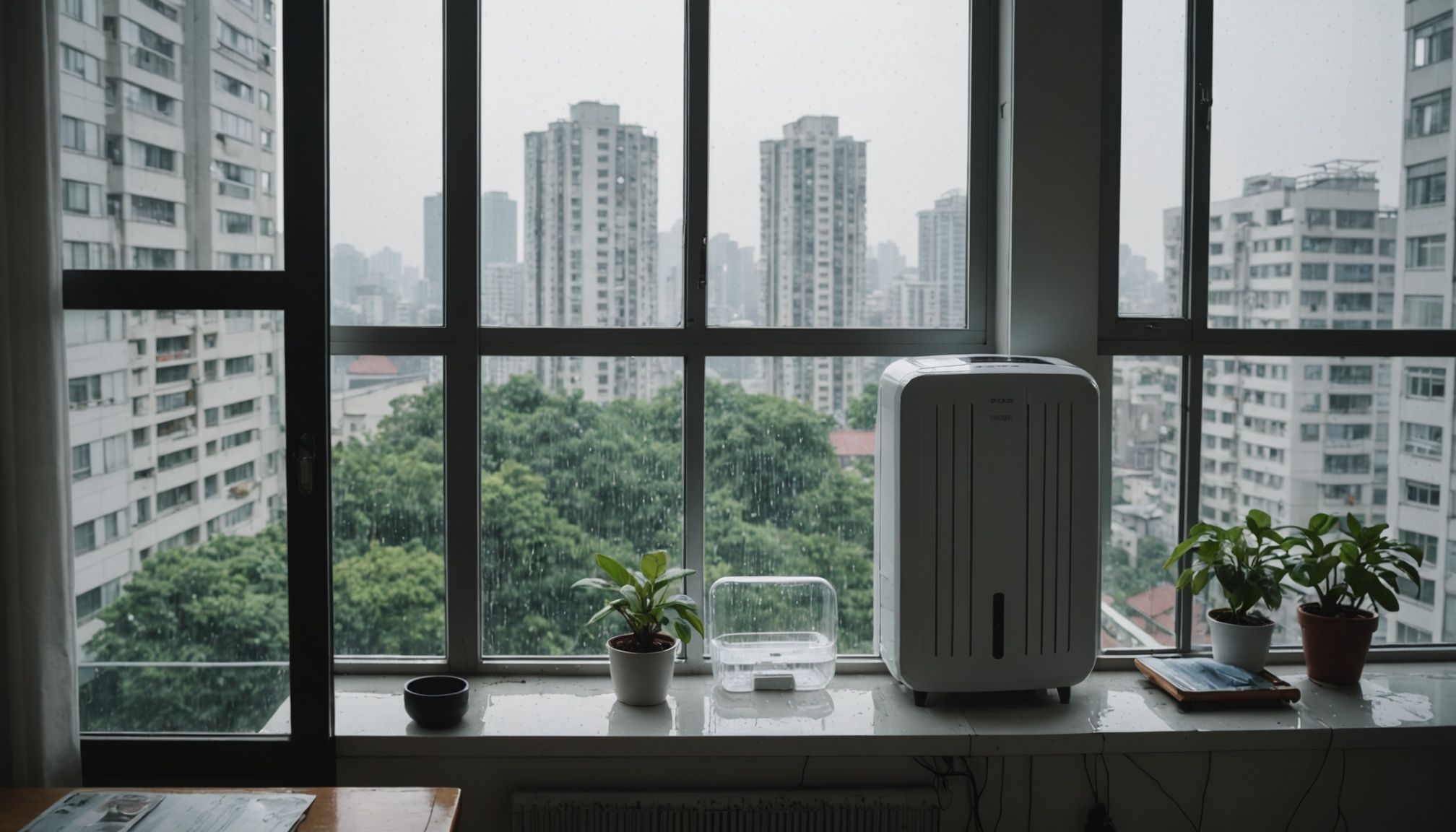
To size a dehumidifier, multiply the floor area of the space you actually dehumidify by 0.76 liters per pyeong (3.3㎡, the standard Korean floor-area unit) for apartments, or 1.02 liters for houses. A 20-pyeong living-and-kitchen area in a Seoul apartment calls for a 15L-class unit, while drying laundry in a closed room needs only a 10L class. Every rainy season the shelves fill with 10L, 16L and 20L models, yet many buyers are unsure whether that number means daily extraction or tank size. Here is how to read the numbers, with a sizing table built from published Korean buying guides.
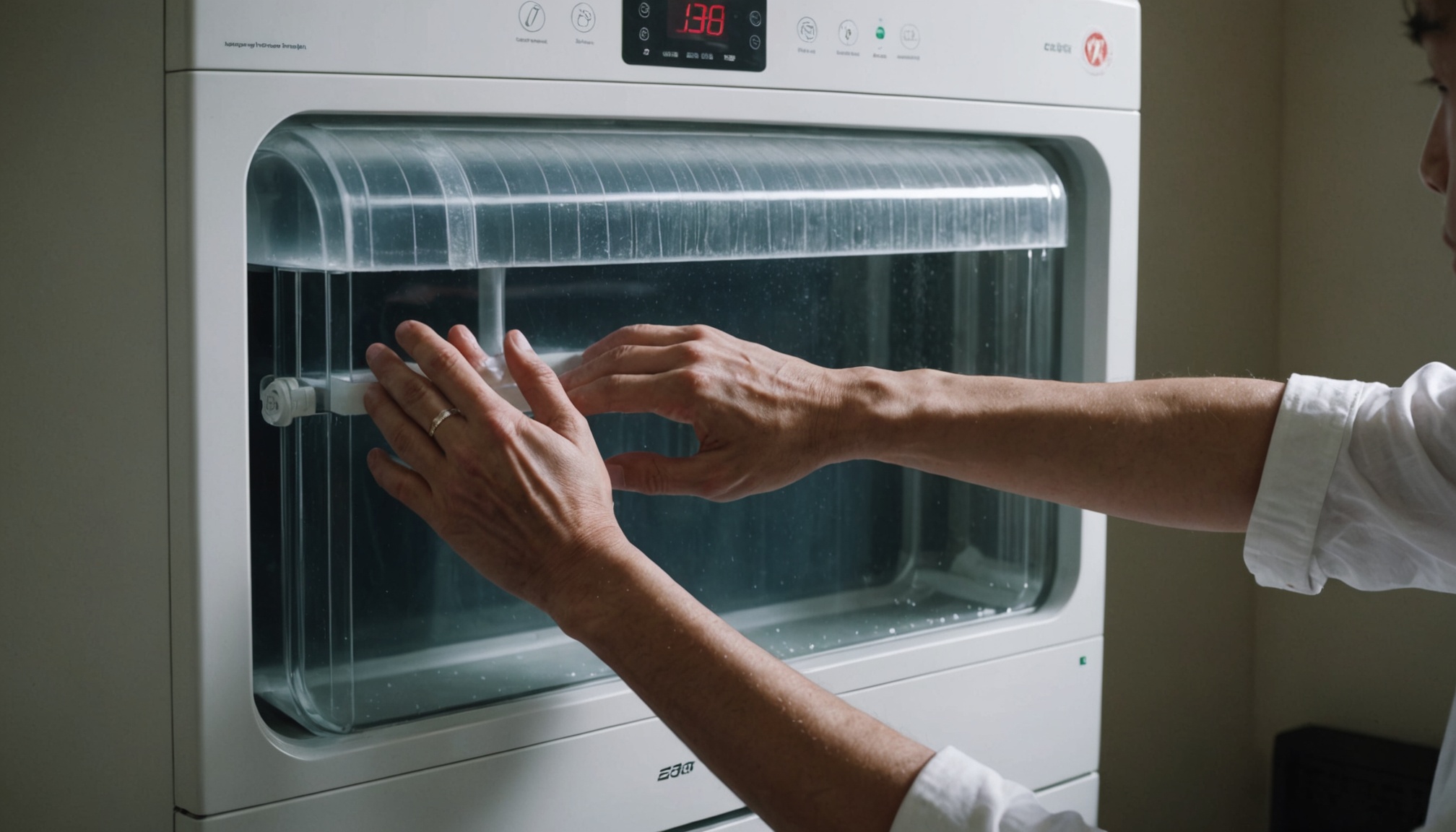
The 10L on the Label Is Daily Extraction, Not Tank Size
The liter figure in a product name is the daily dehumidification capacity — how much moisture the machine can pull from the air in a day. According to the guide by Korean appliance-information service Ajd, the Korean KS standard measures it at 27℃ and 60% relative humidity over 24 hours of operation. Measurement conditions change everything: the same guide notes that the Chinese domestic standard uses 30℃ and 80% humidity — far wetter air — so an imported unit with the same liter label can deliver roughly half the performance under Korean conditions. On a direct-import spec sheet, the first thing to check is not the liter figure but the test condition.
Tank capacity is a separate number entirely. Products featured in the Danawa buying guide carry tanks of 3.0 to 6.5L — far smaller than their daily extraction ratings. If a 10L-per-day unit has a 4L tank, you will empty it two or three times on a humid day running at full tilt. For all-season operation in a laundry room, check whether the unit supports continuous drainage through a hose, bypassing the tank altogether.
How Many Liters Does Your Home Need? The Formula
Ajd's guide gives Seoul-based coefficients: 0.76L per pyeong for apartments and 1.02L per pyeong for detached or multi-family houses. The house coefficient runs about a third higher because houses are less airtight and admit more outside moisture. Regional corrections apply too — humid southern cities rate higher, with Busan at 0.93L (apartment) and 1.25L (house), and Gwangju at 1.05L and 1.39L. The same 20 pyeong needs about 15L a day in a Seoul apartment but 28L in a Gwangju house — nearly double.
Applying the coefficients gives the required daily capacity by room size. When the result falls between market sizes, go one size up.
| Space (pyeong) | Apartment (L/day) | House (L/day) | Market size to buy |
|---|---|---|---|
| 7 (studio / master bedroom) | 5.3 | 7.1 | 6–10L class |
| 13 | 9.9 | 13.3 | 10L apt · 16L house |
| 20 | 15.2 | 20.4 | 16L apt · 20L house |
| 25 | 19.0 | 25.5 | 20L apt · 25L+ house |
The table multiplies each area by the Seoul coefficients (0.76 apartment / 1.02 house). It cross-checks neatly against comparison service Nosearch, which uses 0.232L per square meter for Seoul apartments (about 0.77L per pyeong) and maps a 10L unit to roughly 13 pyeong and a 16L unit to about 21 pyeong — and indeed 13 × 0.76 = 9.9L and 21 × 0.76 = 16.0L.
The number that sizes a dehumidifier is not your home's total floor area — it is the area of the room you close the door on.
Note that the table means the space you actually dehumidify, not the registered floor area of the home. In a 34-pyeong apartment, drying only the master bedroom and walk-in closet involves under 10 pyeong. Conversely, structurally damp spaces — semi-basements, north-facing rooms, rooms with tiny windows — and rooms holding racks of wet laundry should go one size above the calculation, a recommendation both guides share. If you are torn between sizes 1–2L apart, the larger one leaves fewer regrets.
Is 10L Enough If Laundry Drying Is the Main Job?
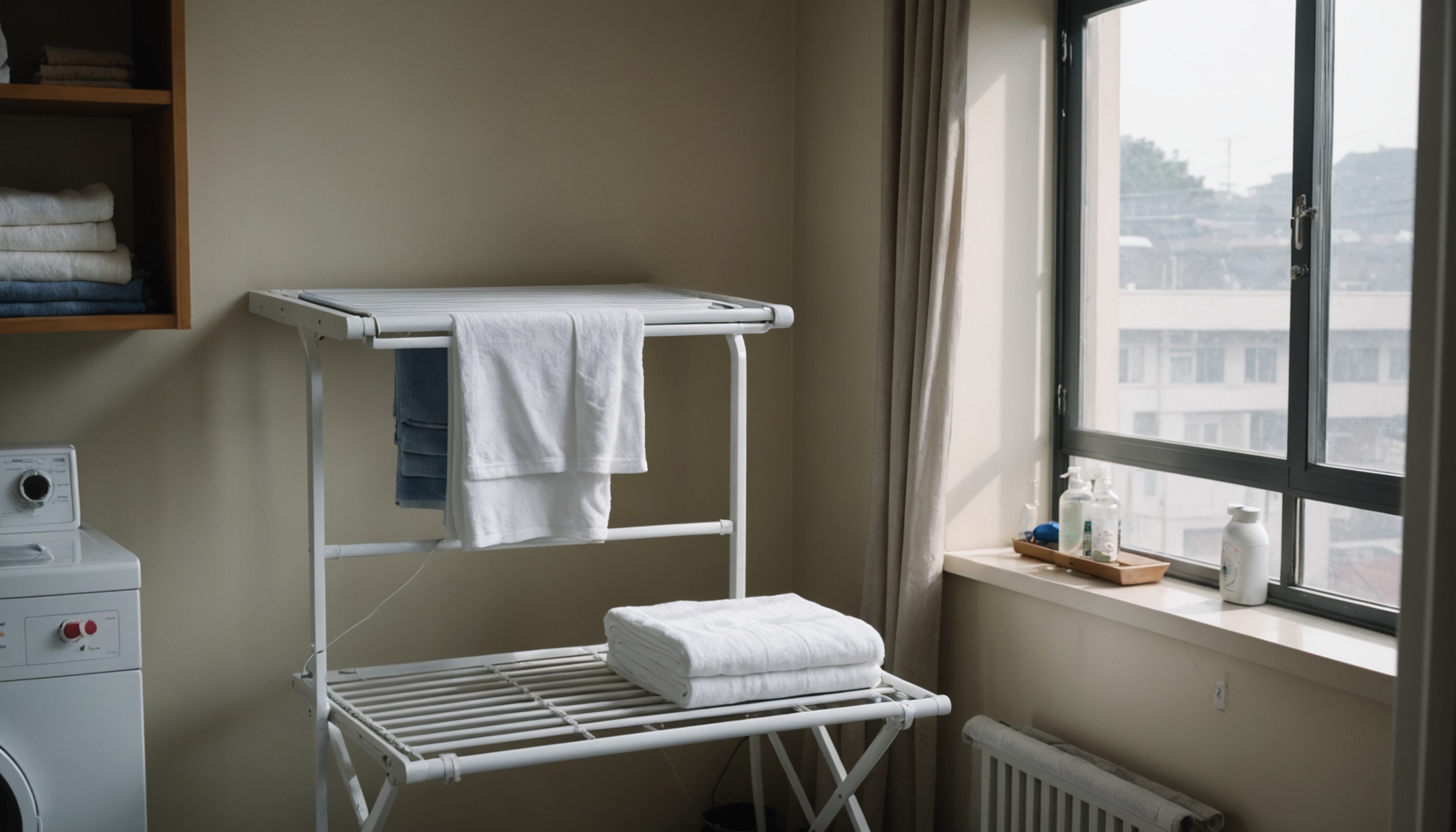
Nosearch's answer leans yes. In Korean homes the dominant uses are drying laundry indoors and dehumidifying bedrooms and wardrobes, and those spaces rarely exceed 10 pyeong — so a 10L class suffices. Even covering the living room and kitchen together, the guide maps homes up to the 20-pyeong range to 10L and 30–40 pyeong homes to 16L. Rating performance by floor area and matching it to your actual room follows the same logic as converting an air purifier's standard coverage area to your room size.
There is also a clear reason not to run one continuously in the living room. Nosearch notes the compressor noise and the warm exhaust air make constant operation unpleasant in occupied spaces — even low-noise models in the Danawa guide run at 32–34dB, a steady library-level hum. In practice, households run the machine in the living room while out, and in a closed room or laundry area at night, keeping people and machine apart. Closing the door on a small space is also the fastest way to drop humidity with a given capacity.
On electricity, the number to read is dehumidification efficiency (L/kWh) — moisture removed per kilowatt-hour, the higher the better. But Ajd's guide estimates high-efficiency models save only 2,000–3,000 won (about $1.50–2.20) a month while costing 100,000–200,000 won more. Take a 150,000 won price gap and 2,500 won monthly savings and payback takes 60 months of continuous use — over a decade if you only run it three or four months each summer. Unlike air conditioning, where inverter versus fixed-speed drive splits the electricity bill structurally, the efficiency premium on a dehumidifier pays back slowly.
Who Should Buy What
Putting the published criteria together, the choice splits like this.
- Studio or single-person household, mainly laundry drying — 6–10L class; continuous drainage helps offset the small tank
- 20-pyeong-range apartment, covering living room and kitchen — 10L is the baseline; frequent indoor drying justifies 16L
- Detached house, semi-basement or north-facing rooms — one size above the calculation; in southern cities recalculate with regional coefficients (0.93–1.05L apartment · 1.25–1.39L house)
- Spec-sheet checklist — test condition (27℃ · 60%) → daily capacity → tank size → continuous drainage → noise (dB)
If a move or major renovation is coming, there is no reason to rush. The required capacity itself depends on housing type and room structure — orientation and airtightness — so run the numbers after the new home's conditions are fixed.