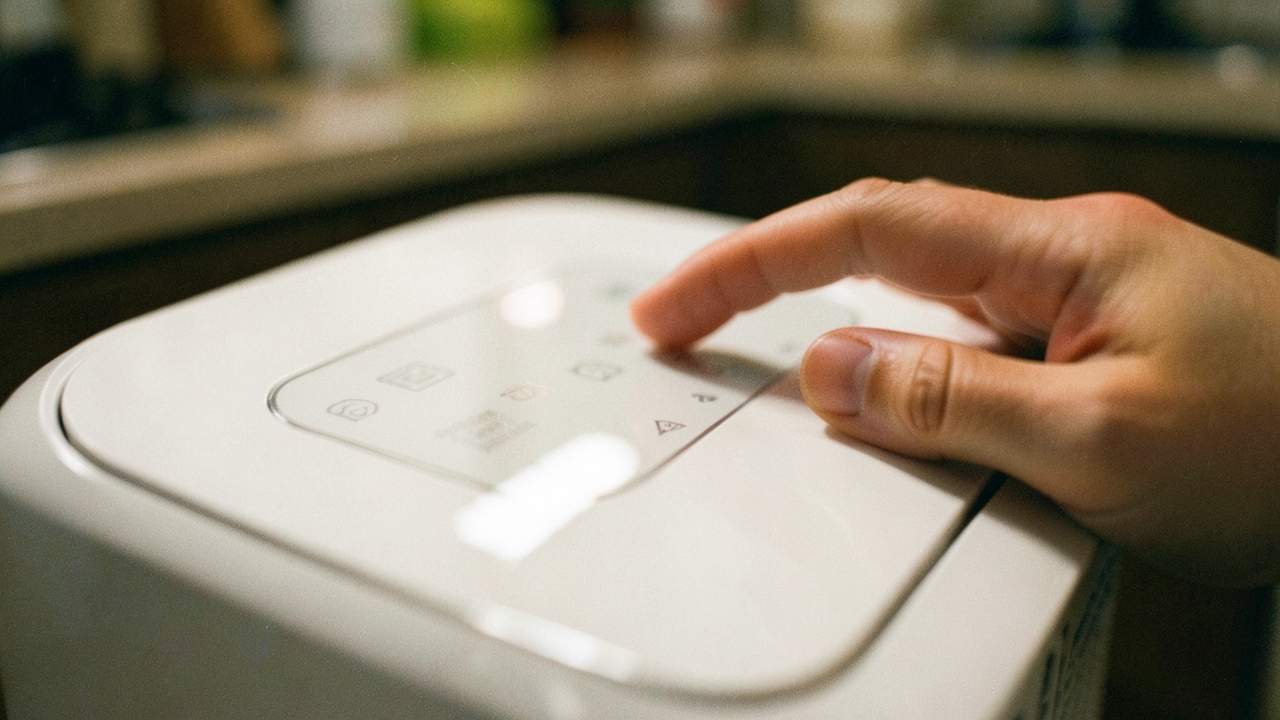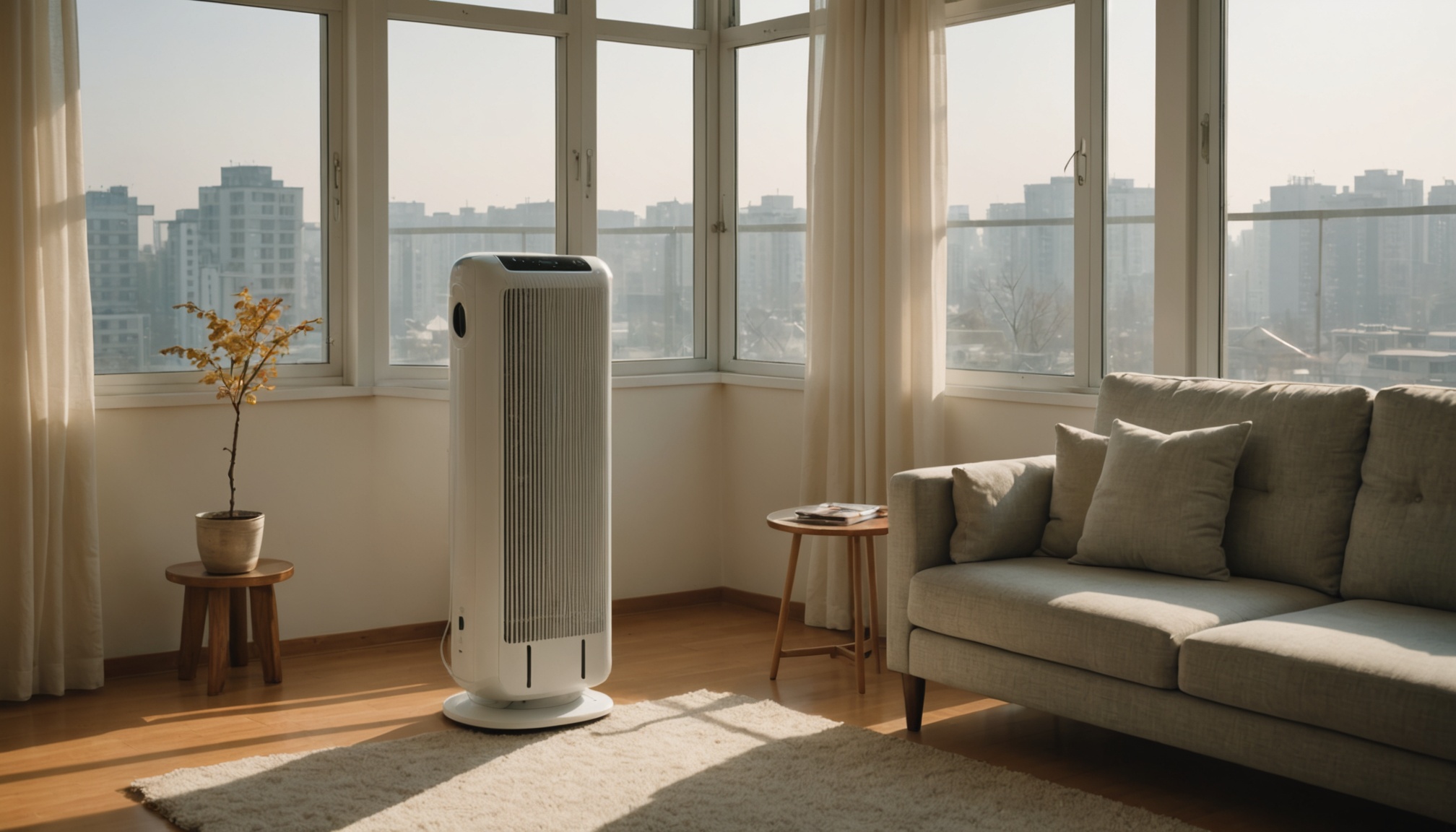
The "30-pyeong" label on an air purifier is not your apartment's floor area. It is the maximum space one unit can handle — the rated coverage area — and it is back-calculated from clean air delivery rate (CADR). The conversion used in Korea is CADR (m³/min) × 7.7 = rated coverage (㎡). That is where the arithmetic for a 33㎡ living room comes from: at least 43㎡ of rated coverage, meaning CADR of 5.6 or more.
The catch is that different standards give different answers for the same room. Korea's Consumer Agency recommends 130% of the space in use, while the manufacturers' association figure cited by the US Environmental Protection Agency demands considerably more. Once you know exactly how far apart those two are, you can fix the CADR you need first instead of chasing the pyeong label printed on the spec sheet.
What conditions produce the rated coverage number
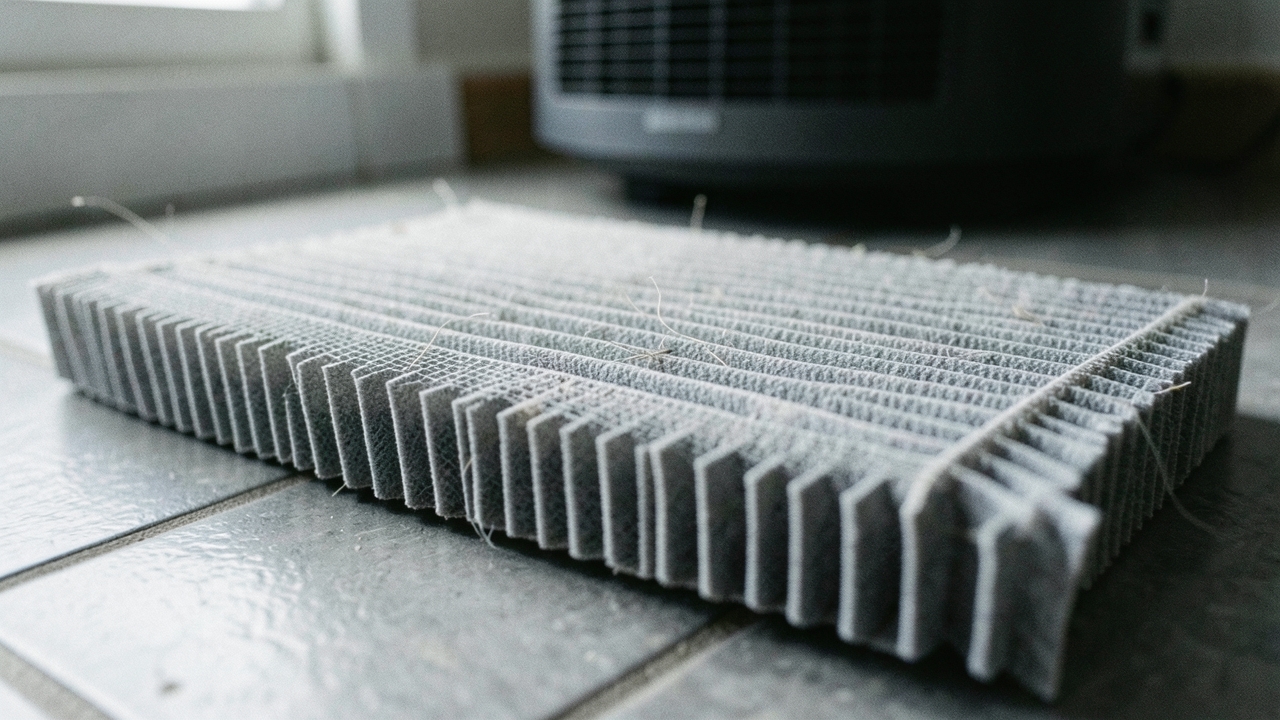
Units sold in Korea are measured under KS C 9314. The test conditions summarised by Nosearch involve a room with one natural air exchange per hour, ten minutes of operation, and measurement of how much 0.3㎛ particulate is removed, all assuming a 2.4m ceiling. Rated coverage therefore does not mean "air stays clean up to this area"; it means "running for ten minutes in this area can cut the initial particle concentration by about half."
Three things are missing from that. Homes that open windows often, ceilings higher than 2.4m, and the fan speed actually used. The test runs at maximum airflow, while most households keep the unit on a medium or lower setting because of noise. The reason not to take the label at face value is a difference in conditions, not a shortfall in performance.
Rated coverage is a performance ceiling measured at maximum airflow, and real use always happens below it.
The same 33㎡ room, 1.8 times the required CADR
Convert the Korean and US standards into the same unit and the gap becomes visible. The Korea Consumer Agency recommendation is rated coverage equal to 130% of the space in use — 65㎡ or more for a 50㎡ living room — while the EPA guide says to pick a unit whose CADR in cfm at least matches the room area in square feet. The looser rule long used by AHAM is two-thirds of that area.
The table below converts all three into CADR in m³/min. Conversions used: 1 pyeong = 3.3058㎡, 1㎡ = 10.764 sq ft, 1 cfm = 0.02832 m³/min.
| Space | Actual area (㎡) | Korean 130% label (㎡) | Korean CADR (m³/min) | AHAM 2/3 CADR (m³/min) | EPA-cited CADR (m³/min) |
|---|---|---|---|---|---|
| Small room, 6 pyeong | 19.8 | 25.8 | 3.4 | 4.0 | 6.0 |
| Master bedroom, 10 pyeong | 33.1 | 43.0 | 5.6 | 6.7 | 10.1 |
| Living room, 15 pyeong | 49.6 | 64.5 | 8.4 | 10.1 | 15.1 |
| Living room + kitchen, 20 pyeong | 66.1 | 86.0 | 11.2 | 13.4 | 20.2 |
| Open plan, 25 pyeong | 82.6 | 107.4 | 14.0 | 16.8 | 25.2 |
The ratios between the columns hold no matter how large the room gets: the EPA-cited figure is 1.8 times the Korean 130% rule, and the AHAM two-thirds rule is 1.2 times. The Korean approach is not lax — it targets something else. Korea's number aims at halving concentration in ten minutes; the US figures aim at four to five air changes per hour. For a closed room run all day on a low setting, 130% is enough. Where pollution keeps entering — pets, cooking smoke, right after airing out the flat — air changes per hour start to matter, and the number you need sits closer to the right-hand column.
Is one unit enough for a 100㎡ apartment?
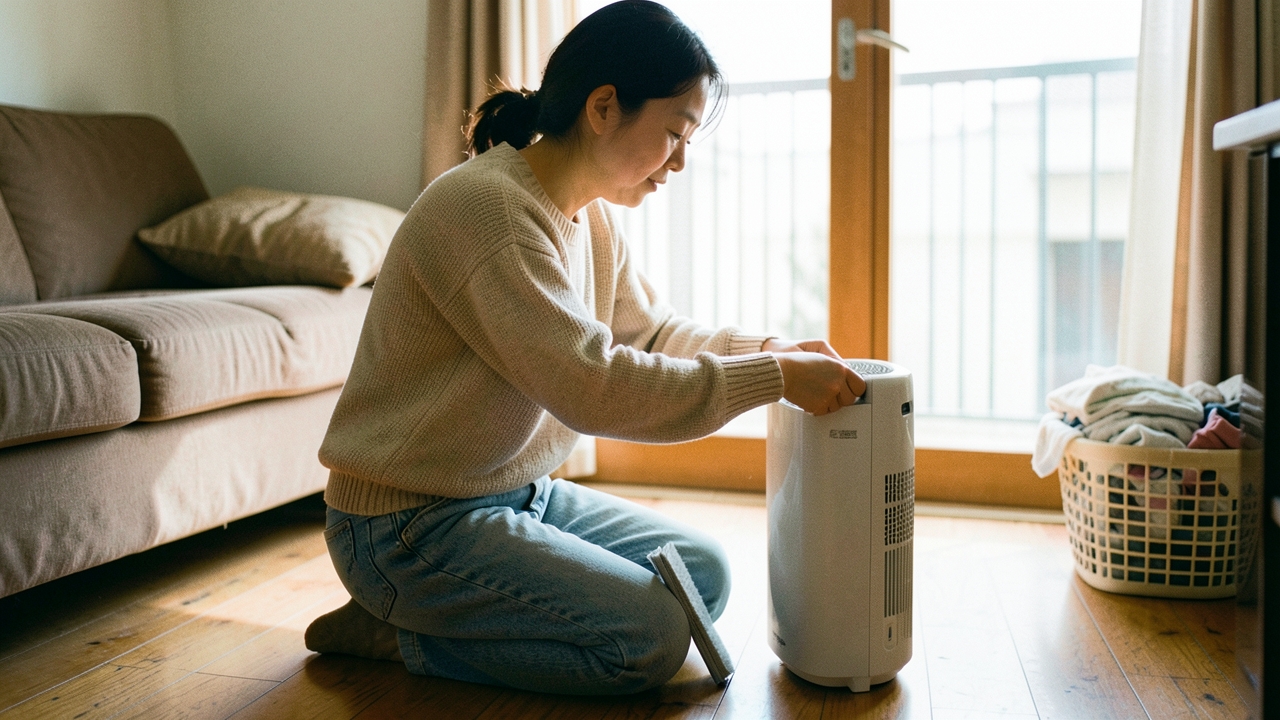
No. Rated coverage assumes a single connected space with doors open, so areas cannot be added up where doors close. The EPA likewise advises sizing for the whole space the unit will serve in an open floor plan. In practice the order looks like this.
- For a living room and kitchen joined as one space, add both areas first, then apply 1.3 to 1.5 times.
- Bedrooms are used with the door shut for long stretches, so a separate small unit per room secures more air changes than one large unit in the living room.
- For ceilings above 2.4m, such as duplex or pilotis layouts, raise the target CADR by 1.3 times.
- Two units labelled for the same pyeong can differ in measured CADR by up to a factor of two, so compare CADR or rated coverage figures rather than the pyeong label.
Rated coverage can be checked in the Korea Energy Agency's public data, where models sold domestically must disclose the figure in ㎡. That is where advertising language such as "high capacity" can be tested against the actual value. Note that the approach differs from heating and cooling appliances: air conditioners are sized by cooling capacity per pyeong, whereas for purifiers the operative measure is air changes rather than area.
What to check after capacity — filters, noise, running cost
Once CADR is settled, what remains is running cost and noise. Based on published specifications, the order of checks looks like this.
| Item | Example spec | How to judge it |
|---|---|---|
| Rated coverage | 65㎡ | 130–150% or more of actual area in use |
| CADR | 8.4 m³/min | Check it back-calculates as coverage ÷ 7.7 |
| HEPA filter grade | H13 | H13 is effectively the baseline |
| Filter replacement | 6–12 months | Confirm whether it assumes 8 or 24 hours daily |
| Pre-filter type | Removable, washable | Washing every 2–4 weeks extends main filter life |
| Gas removal | CA certification | Certification covers 70%+ gas removal, ozone, noise |
| Sensor | PM2.5 | A single PM2.5 sensor suffices for auto mode |
The Nosearch guide flags the assumption buried in filter-life claims: whether "6 to 12 months" assumes eight hours a day or twenty-four changes annual running cost by two or three times. Triple-sensor arrays covering PM10, PM2.5 and PM1.0 also add limited value, since ambient standards themselves target PM2.5 and larger particles. When choosing seasonal appliances together, the same habit applies as with sizing a dehumidifier in litres by floor area — look for the number that comes with test conditions attached before the marketing label.

Who each option suits
Judging on published specifications alone, the choice splits by usage conditions.
- Mostly bedroom use with the door closed: small units rated 25–43㎡ (CADR 3.4–5.6), one per room. Check noise specs first.
- All-day operation in a joined living room and kitchen: rated coverage of 86㎡ or more (CADR 11.2+). Headroom to run long hours on a low setting is the point.
- Pets, cooking smoke, frequent airing: size to the EPA column, or split the load across two mid-size units.
- Worth waiting on: units with a large pyeong label but no published CADR, and units with a fixed pre-filter, until running costs are clear.