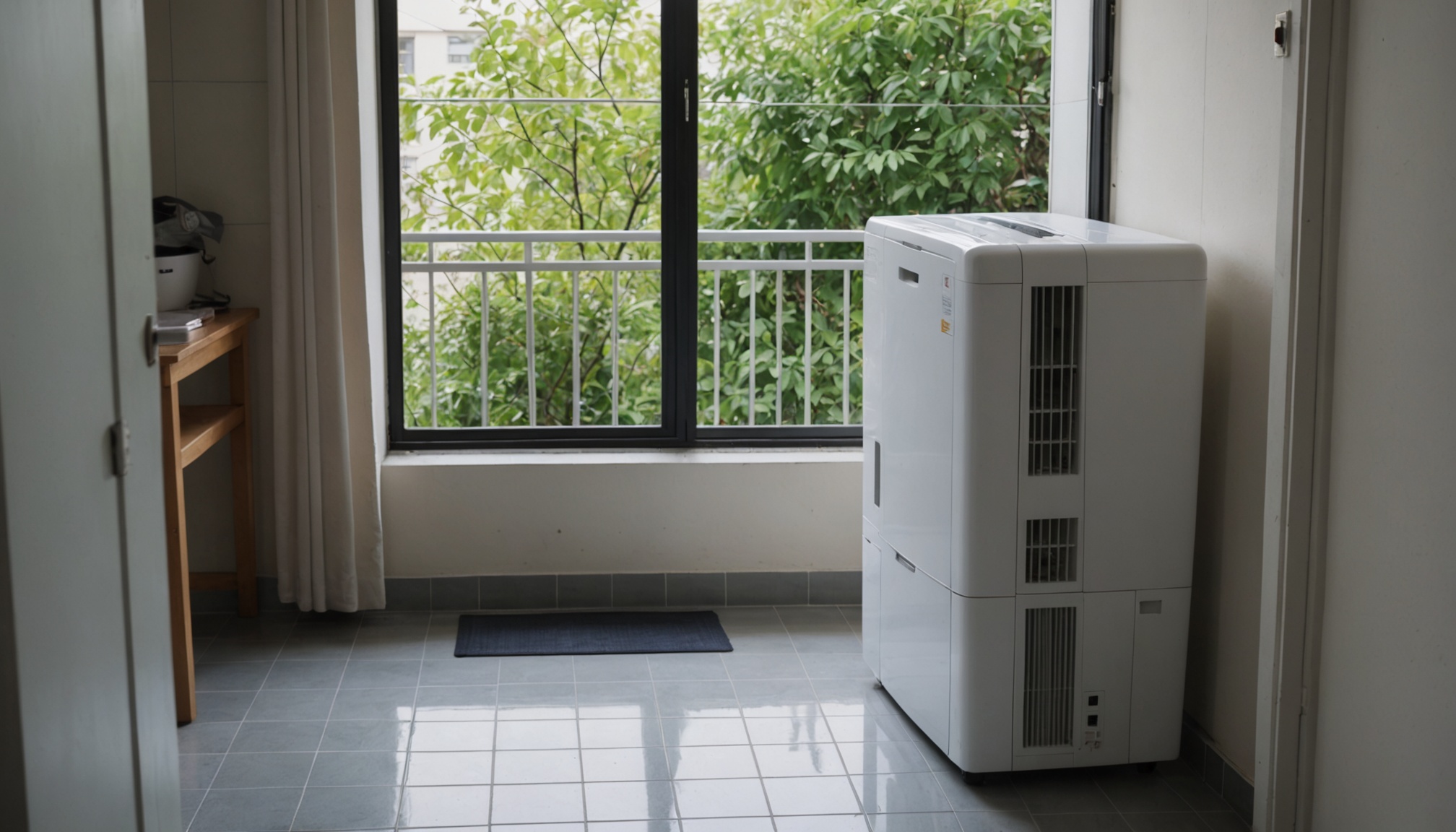
Sizing a dehumidifier starts with one multiplication: floor area in pyeong (one pyeong is about 3.3 square metres) times 0.76 L. A 20-pyeong apartment space needs 15.2 L a day; a detached house uses a higher coefficient of 1.02 L per pyeong, giving 20.4 L. But the "20 L daily extraction" printed on the box is not a performance ceiling — it is a coordinate measured at one specific temperature and humidity. Without knowing which coordinate, two units both labelled 20 L can differ by more than 30% in real capability.
The basis for the rating is the Korean Industrial Standard KS C 9317 (electric dehumidifiers). It fixes indoor conditions at a dry-bulb temperature of 27C and 60% relative humidity, and takes the water removed over 24 hours as rated capacity. Spec sheets from Korean manufacturers carry the same footnote: 27.0 plus or minus 1.0 C, humidity 60 plus or minus 3%. The printed figure belongs to those conditions and falls when the room is cooler or drier.
Why two units labelled 20 L differ by 30%
The gap opens because overseas test conditions differ. Extraction figures measured in China are based on 30C and 80% relative humidity — a far more humid environment than the Korean standard. The Danawa DPG buying guide notes that a rating obtained under those conditions falls to roughly 70% when converted to the Korean 27C and 60% basis.
Put numbers in and the difference is clear. A unit rated 20 L at 30C and 80% delivers about 14 L under the Korean standard — short of the 15.2 L that a 20-pyeong apartment space requires. A domestic unit rated 16 L under KS conditions stays 16 L and covers the same room comfortably. Compared as printed, 20 L looks larger than 16 L; normalised for conditions, the order reverses.
A product page that emphasises extraction volume without stating test conditions is likely the one that needs converting. Looking for "27C, 60%" or a KS C 9317 reference in the spec table is the faster check. Where no condition is stated, discounting the printed capacity to 70% is the safe assumption.
How many litres does a 20-pyeong apartment need?
Capacity per unit area follows the coefficients compiled by the Korea Air Cleaning Association: 0.76 L per pyeong for apartments and 1.02 L per pyeong for detached houses. The 34% higher house coefficient reflects differences in insulation, airtightness and exposed exterior surface. For a semi-basement, a low floor above an open pilotis, or a room with an attached bathroom, an apartment is better assessed against the house coefficient.
The table below multiplies both coefficients by floor area, then maps the result onto the capacity tiers actually sold. Because commercial units come in 10, 12, 16, 20 and 25 L steps, no model matches the calculated figure exactly; the method is to take the nearest tier at or above it.
| Floor area (pyeong) | Apartment requirement (L/day) | Detached house (L/day) | Matching rated tier |
|---|---|---|---|
| 10 | 7.6 | 10.2 | 10 L class |
| 15 | 11.4 | 15.3 | 12-16 L class |
| 20 | 15.2 | 20.4 | 16-20 L class |
| 25 | 19.0 | 25.5 | 20-25 L class |
| 30 | 22.8 | 30.6 | 25 L class and up |
| 40 | 30.4 | 40.8 | 30 L class and up |
One common misreading: the area here is the space the unit sits in, not the whole home. A 6-pyeong bedroom behind a closed door does not call for a 25 L machine just because the apartment totals 34 pyeong; conversely, an open living-and-kitchen layout used with doors open will outrun a figure calculated for a single room. The same structural error with rated coverage area recurs in the piece on air purifier standard coverage area.
What 2.0 L/kWh means on the electricity bill
If capacity answers how much water comes out, dehumidification efficiency answers how much electricity it took. The formula divides litres removed by kilowatt-hours consumed, giving L/kWh. Commercial products fall roughly between 1 and 4 L/kWh, and anything above 2 counts as efficient. Korea's energy efficiency grade for dehumidifiers is assigned on this same metric.
The figure converts straight into consumption. Fix a target volume and divide by efficiency. Removing 120 L a month — 4 L a day over 30 days of operation — works out as follows.
| Efficiency (L/kWh) | Consumption for 120 L/month (kWh) | Extra vs 2.36 (kWh) |
|---|---|---|
| 1.50 | 80.0 | +29.2 |
| 1.79 | 67.0 | +16.2 |
| 2.00 | 60.0 | +9.2 |
| 2.36 | 50.8 | baseline |
The spread between 1.5 and 2.36 is 29.2 kWh a month. What that costs depends entirely on which progressive tariff bracket the household sits in. For a home already in an upper bracket the same 29.2 kWh can cost more than double what it costs a lower-bracket home, so calculating bracket exposure first comes before any single appliance.
Reported differences between grades are smaller than expected. Nosearch's comparison of dehumidifier efficiency grades puts the monthly gap between grade 1 and grade 3 at a maximum of 3,000 to 4,000 won under a standard 171 hours of monthly operation. The same source cites roughly 270 W for a grade 1 unit rated at 16 L a day: about 10,000 won a month on a naive calculation, but 7,000 to 8,000 won in practice because power draw varies once the target humidity is reached. In a home that runs the unit for short stretches, recovering a grade 1 price premium takes a long time.
Rated capacity is not a performance ceiling but a coordinate measured at a single point: 27C and 60% relative humidity.
Three more lines worth reading in the spec table
Beyond capacity and efficiency, some entries are easy to skip. The first is low-temperature operation. Compressor-type dehumidifiers lose extraction sharply once frost forms on the evaporator, so the operating temperature range of the defrost function should be stated. For spring and autumn use, or an unheated room, that line matters more than rated capacity.
The second is the noise figure. The DPG guide puts units rated around 20 L a day at roughly 50 dB. For a bedroom running overnight, what decides satisfaction is which operating mode the quoted noise was measured in and how much extraction drops in quiet mode. Maximum extraction and minimum noise are not simultaneous specifications.
The third is tank volume and continuous drainage. A unit pulling 15 L a day with a 3 L tank needs emptying five times over. The larger the rated capacity, the shorter the emptying interval, which makes hose drainage effectively mandatory on high-capacity models.
When it fits, and when there is no hurry
- A fit on published specs — a single room behind a closed door with a calculated figure under 10 L is served by a 10-12 L class unit. An open space of 20 pyeong or more including a living room starts at 15 L.
- Round up one tier — semi-basements, low floors, rooms with attached bathrooms, and homes that dry laundry indoors year-round. Apply the 1.02 L house coefficient rather than 0.76 L.
- Grade 1 matters less when — daily runtime is short and use is seasonal; a 3,000-4,000 won monthly gap will not recover a price premium. Prioritise low-temperature operation and hose drainage instead.
- No stated condition means 0.7x — assume a 30C and 80% basis and convert to 70% of the printed capacity before comparing against the table.
- Reasons to wait — if the calculated figure already fits the rated capacity of the current unit, the case for replacing is efficiency, noise and drainage, not litres. A new model that improves none of the three offers little.