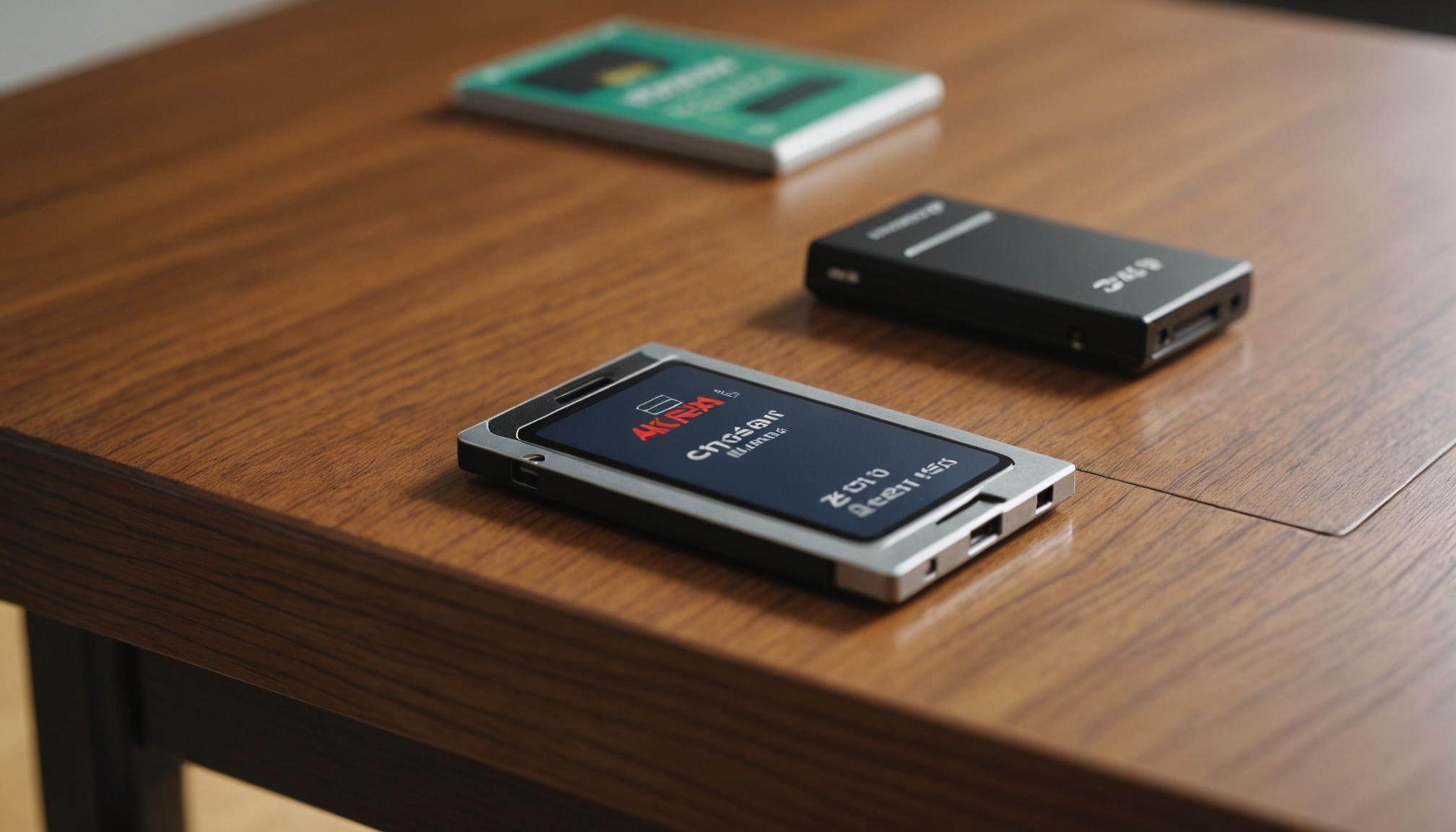
The V30 and U3 marks on a microSD card point at the same number. Both guarantee a minimum sequential write speed of 30MB/s; only the labelling system differs. The A2 stamped beside them is not a speed grade at all but an IOPS specification, and the EX mark the Nintendo Switch 2 demands is not a grade either — it signals a different interface altogether.
That is why a single card carries four or five symbols. Each measures a different axis, so a high value on one does not pull the others up with it. Breaking those axes apart, using the published SD Association specifications, is what makes it clear which symbol matters for which use.

Why one card carries four different symbols
The SD Association's speed class framework has four branches. Speed Class is written as a number inside a circle (C2, C4, C6, C10); UHS Speed Class as a number inside a U (U1, U3); Video Speed Class with a leading V (V6, V10, V30, V60, V90); and Application Performance Class with a leading A (A1, A2). SD Express adds its own separate tiers: E150, E300, E450 and E600.
| Class system | Notation | What it measures | Guaranteed floor |
|---|---|---|---|
| Speed Class | C2 / C4 / C6 / C10 | Minimum sequential write | 2 / 4 / 6 / 10 MB/s |
| UHS Speed Class | U1 / U3 | Minimum sequential write | 10 / 30 MB/s |
| Video Speed Class | V6 / V10 / V30 / V60 / V90 | Minimum sequential write for video | 6 / 10 / 30 / 60 / 90 MB/s |
| Application Performance Class | A1 / A2 | 4KB random read/write plus sustained write | 1,500·500 IOPS / 4,000·2,000 IOPS, both 10MB/s |
| SD Express Speed Class | E150 / E300 / E450 / E600 | Minimum NVMe-based sequential speed | 150 / 300 / 450 / 600 MB/s |
The bus interface is a separate matter again. V6 and V10 apply across High Speed and UHS, V30 to UHS, and V60 and V90 only to UHS-II and above. One row of contacts on the back means UHS-I, whose theoretical ceiling is 104MB/s; two rows mean UHS-II. That physical limit is why a V90 card cannot ship with a single row of contacts.
A class mark is not an advertisement of top speed. It is a promise about the floor — what the card still manages on its worst pass.
V30 and U3 are the same 30MB/s
Seeing U3 and V30 side by side on one card is redundancy, not two different capabilities. UHS Speed Class arrived alongside the UHS bus in 2009; Video Speed Class was added later with 4K and 8K recording in mind. Where the two systems overlap at 30MB/s, manufacturers print both for compatibility.
The difference is that Video Speed Class extends past where U3 stops. V60 and V90 apply only to the UHS-II and UHS-III families, and there is no tier above U3. For high-bitrate or 8K work, then, the V mark is the one that carries information; the U mark has run out of range.
C10 likewise means the same 10MB/s as U1. Three systems are stamping the same floor with different glyphs.

Back-calculating the grade you need from bitrate
Dividing a video bitrate by eight gives the required write speed in MB/s. Running representative recording bitrates through that conversion shows exactly where each grade runs out of room.
| Recording mode | Bitrate (Mbps) | Write needed (MB/s) | Minimum grade | Headroom vs V30 (x) |
|---|---|---|---|---|
| FHD 60p standard | 28 | 3.5 | V6 | 8.6 |
| 4K 30p standard | 100 | 12.5 | V30 | 2.4 |
| 4K 60p | 150 | 18.8 | V30 | 1.6 |
| 4K 120p high frame rate | 300 | 37.5 | V60 | 0.8 |
| 8K 30p | 400 | 50.0 | V60 | 0.6 |
4K 30p needs 12.5MB/s. A V10 card, at a 10MB/s floor, falls short on specification alone, while V30 leaves 2.4 times the headroom. Push to 4K 120p and the requirement jumps to 37.5MB/s — V30's headroom drops to 0.8, meaning the guaranteed floor sits below the demand. Two modes both labelled 4K can sit more than a full grade apart depending on frame rate and codec.
Headroom is worth computing precisely because these grades describe a floor. As a card fills and files fragment, effective speed drifts toward that floor. When the requirement and the guaranteed floor sit within about 1.2x of each other, long recordings retain real room to drop frames.

A2 is not a faster card — it is a card apps can run on
Application Performance Class measures 4KB random access rather than sequential throughput. A1 requires 1,500 random read IOPS and 500 random write IOPS; A2 raises those to 4,000 and 2,000. The sustained sequential write requirement is identical at 10MB/s for both.
Converting IOPS into MB/s makes the difference in axis obvious. A2's 4,000 read IOPS multiplied by 4KB works out to roughly 15.6MB/s, and 2,000 write IOPS to roughly 7.8MB/s — around half of V30 in sequential terms. That is why an A2 card cannot be described as faster than a V30 card. A2 targets the opposite situation: not one large file poured in continuously, but countless small reads scattered across the card.
Installing apps to a card on an Android device, or a console pulling in game assets split into small chunks, is that situation. In a camera or a dashcam writing large files sequentially, the gap between A1 and A2 barely shows up in the result. The structure mirrors the way power rating and data speed are separate axes on a USB-C cable.
The Switch 2's EX mark is an interface, not a grade
Nintendo's official guidance states that the Switch 2 is compatible only with microSD Express cards, and that ordinary microSD cards cannot store or read downloaded software. Existing cards can still be read for screenshots and video clips, and supported capacity tops out at 2TB. When buying, the EX mark has to appear alongside the microSD mark.
The interface changed, not the grade. As Digital Focus reports, the older UHS-I standard caps at 104MB/s, while microSD Express uses a PCIe interface with the NVMe protocol, opening a theoretical ceiling of 3,940MB/s; shipping products have been quoted at around 880MB/s read and 650MB/s write. Since the lowest SD Express tier, E150, already guarantees 150MB/s, even the slowest Express card clears the UHS-I ceiling.
Which means a V90 card still cannot hold Switch 2 games. V90 rides on UHS-II contacts and Express rides on PCIe contacts — no amount of grade climbing crosses that gap.
Who each grade fits
- Action cameras and dashcams recording no higher than 4K 30p: V30 or U3, which leaves 2.4x headroom on specification.
- 4K 60p and above, or high frame rate modes: V60 or higher. V30's floor sits below the requirement at 4K 120p.
- 8K or high-bitrate codecs: V90 with UHS-II contacts. This combination cannot exist on a UHS-I card.
- Running apps from the card on an Android device, or loading game assets: A2. Choose on IOPS, not sequential speed.
- Pure photo and video storage: A1 is sufficient. A2's random performance never surfaces in this use.
- Nintendo Switch 2: a card without the EX mark cannot hold games. Check for the mark before reading any speed grade.