
The 65W on a charger's shell is what it delivers to one device on one port. USB Power Delivery is a negotiation: charger and device agree on a voltage and a current, so the wattage that actually flows depends on the voltage step, the cable's rating, and how many ports are occupied at once. Published specifications show the gap plainly — Samsung's 65W three-port charger splits into 35W, 25W and 5W once three devices are connected.
That narrows the buying question to two things: which voltage step your device asks for, and whether the cable in your hand can carry it. What follows works from the specification documents and the manufacturer's published figures.
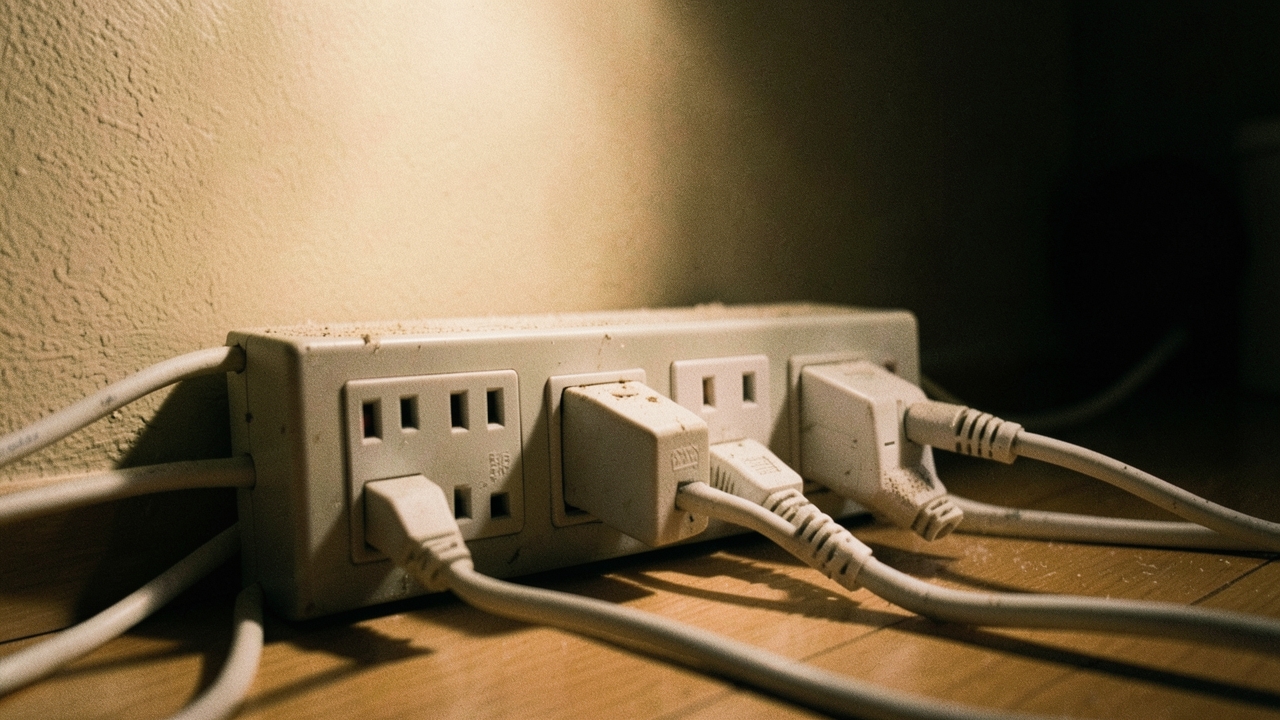
Watts are volts times amps
USB PD does not let a device draw an arbitrary wattage. Maximum power is a fixed voltage multiplied by the current the cable and device can sustain. According to GraniteRiverLabs' explainer on PD 3.1, the Standard Power Range (SPR) uses fixed voltages of 5V, 9V, 15V and 20V and tops out at 100W, while the Extended Power Range (EPR) adds 28V, 36V and 48V and reaches 240W at 48V and 5A.
Expanding that rule into simple multiplication shows where the familiar numbers on charger boxes come from.
| Range | Fixed voltage (V) | Max with a 3A cable (W) | Max with a 5A cable (W) |
|---|---|---|---|
| SPR | 5 | 15 | 25 |
| SPR | 9 | 27 | 45 |
| SPR | 15 | 45 | 75 |
| SPR | 20 | 60 | 100 |
| EPR | 28 | - | 140 |
| EPR | 36 | - | 180 |
| EPR | 48 | - | 240 |
Each figure is voltage multiplied by current. The 3A column is empty in the EPR rows because everything above 20V is defined for 5A only. Two things fall out immediately: what separates 60W from 100W is 3A versus 5A at the same 20V, and anything past 140W requires the voltage itself to climb above 28V rather than the current to rise.
It also means a charger labelled 45W might be 9V at 5A or 15V at 3A. Same number, different negotiation — and if the device does not request that step, the figure never appears.
Past 100W, the cable changes first
Plugable's EPR write-up puts EPR at 28V, 36V and 48V at 5A for up to 240W, with 48V as the voltage ceiling. The cable condition is explicit: EPR cables must be visibly marked so users can identify 240W support in order to be certified. Older 20V 5A cables are being phased out, and the minimum voltage rating for internal bypass capacitors rises from 30V to 63V.
Translated into a buying rule, it is simple. Buy a 240W charger and pair it with a 100W cable and the link stops at 20V 5A. Reverse it — a 240W cable on an SPR-only charger — and nothing above 28V is ever negotiated. The lowest-rated of charger, cable and device sets the ceiling.
Power and data are separate specifications on the same connector, which is a related source of confusion; that distinction is covered in the comparison of USB4 and Thunderbolt 4 and 5 bandwidth specs.
Charging speed is decided not by the number printed on the charger, but by the lowest step that charger, cable and device can all agree on.
Without PPS, a Galaxy is not fast-charging
Fixed voltage steps cannot track precisely what a battery wants, which is why PD includes PPS (Programmable Power Supply) — voltage adjustable in 20mV increments and current in 50mA increments, negotiated in real time. The same source distinguishes it from the EPR range's AVS, which adjusts voltage in 100mV steps and does not support current-limit operation.
PPS matters at purchase because manufacturer fast-charging modes sit on top of it. Samsung's product page for its 65W trio-port charger states that the unit supports Super Fast Charging 2.0 (PPS 45W) for the Galaxy S20 Ultra, Note10+ and later. On published specifications, a charger without PPS drops the negotiation back to fixed voltage steps regardless of its wattage label.
This is what gets missed when total output is the only number read. A 100W charger with no PPS entry never enters a Galaxy's fastest charging band, while a 25W or 45W unit that supports PPS does. The line to find in a spec sheet is PPS support and its range, not the headline wattage.
A three-port 65W charger is not 65W
Total output on a multi-port charger is not the sum of its per-port maximums. On the same Samsung page, per-port maximums are 65W for the main USB-C, 25W for the secondary USB-C and 15W for the USB-A. Connect three devices at once and the total 65W is divided into 35W, 25W and 5W — the main port's 65W falls to 35W.
Dividing a battery capacity by those figures gives a sense of the difference. Take a laptop with a 70Wh battery and assume 85% charging efficiency.
| Connection state | Power to the laptop (W) | Time for 70Wh at 85% efficiency |
|---|---|---|
| Laptop alone on the main USB-C | 65 | About 1 hour 16 minutes |
| Main USB-C with three devices connected | 35 | About 2 hours 21 minutes |
| Laptop on the secondary USB-C | 25 | About 3 hours 18 minutes |
These are straight conversions of capacity divided by delivered power and efficiency; real charging runs longer because current tapers near the top of the cycle. The direction still holds. On a multi-port charger, the number worth checking is not the total output on the box but the split table further down the specification sheet.
Which port takes which device changes the outcome too — a laptop on the secondary USB-C is capped at 25W even with nothing else plugged in. How charging habits affect longevity is covered separately in the piece on battery cycle specifications.

Who each option suits
- Charging one phone only — a single-port unit with PPS somewhere in the 25W to 45W range is enough; a higher total output negotiates the same step
- Carrying a laptop and a phone together — the criterion is whether the main port still delivers 45W or more with everything connected, not the total figure
- Running a high-performance laptop past 20V 5A, meaning above 100W — check the cable's 240W marking before the charger's spec sheet
- GaN branding describes the semiconductor material, not the power class — at equal wattage, read it as a difference in size and thermal design
There is also a clear case for waiting. If everything you own tops out inside SPR's 100W, an EPR 240W product buys nothing today. That range only opens when charger, cable and device all support EPR, and without such a device in hand the money goes entirely into headroom.