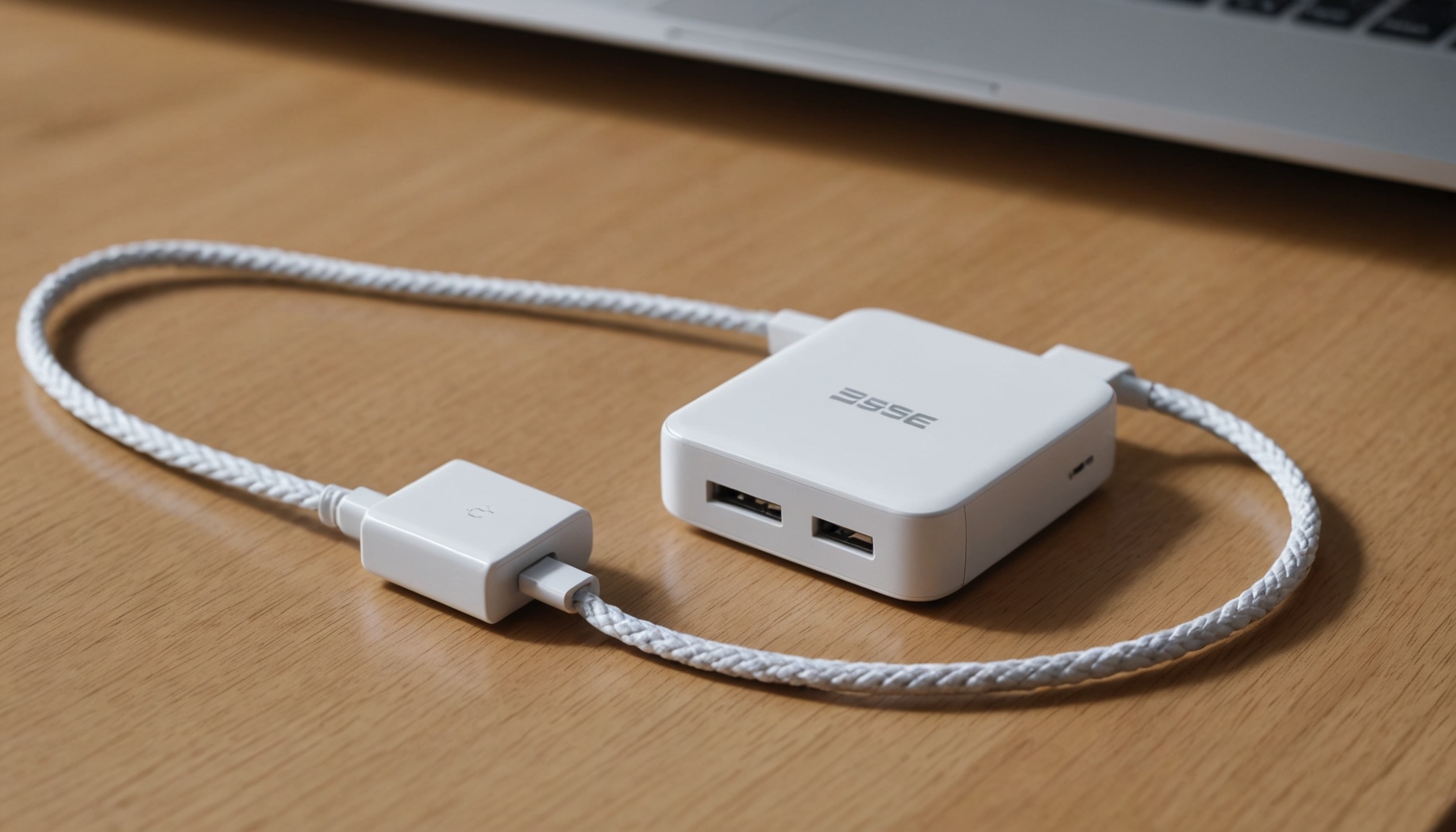
Filling a 4,800mAh battery at 45W takes a theoretical minimum of 25 minutes. Published full-charge measurements for phones of that class tend to land at about double it. The arithmetic is not wrong; the problem is that 45W only actually flows for less than half of the charge.
Doubling adapter output does not halve charging time, and the reason sits in how lithium-ion cells are charged. Below, the points where the wattage on the box stops matching reality, worked through in order.
Convert mAh to Wh Before Dividing
Charger output is rated in watts, battery capacity in mAh. They are not on the same axis until you multiply mAh by the cell's nominal voltage to get watt-hours. Nominal voltage for a phone lithium-ion cell typically sits between 3.8V and 3.88V; 3.85V is used here. Manufacturers do not publish Wh, so this is an assumption and is flagged as such. The same conversion logic appears in our piece on converting power bank mAh into Wh.
The reference devices are the 2026 foldables. SK Telecom's newsroom review of the Galaxy Z Foldable8 series reports that the Z Fold8 carries a 4,800mAh battery and the Fold8 Ultra 5,000mAh, both with 45W wired and 20W wireless charging. The Fold8 uses a silicon-carbon cell to add capacity without adding thickness.
4,800mAh × 3.85V = 18.48Wh. Divide by charger output and you get the floor assuming zero loss. In practice the adapter's voltage conversion and the phone's charging IC shed some of it as heat, so applying 85–90% efficiency is the realistic version.
| Charger output | Theoretical minimum (min) | At 90% efficiency (min) | At 85% efficiency (min) |
|---|---|---|---|
| 15W | 73.9 | 82.1 | 87.0 |
| 25W | 44.4 | 49.3 | 52.2 |
| 45W | 24.6 | 27.4 | 29.0 |
| 65W | 17.1 | 19.0 | 20.1 |
On paper, moving from 25W to 45W saves 22 minutes. Why that saving does not materialise is the next section.
45W Only Flows for Part of the Charge
Lithium-ion cells charge in a constant-current, constant-voltage cycle. As LG Energy Solution explains, charging begins in a CC phase that holds current steady, then switches to a CV phase once cell voltage reaches its ceiling, holding voltage fixed while current tapers away. It is a safety design against overvoltage, and charging ends when current falls to a cutoff value.
Power is voltage times current. Once the CV phase begins, voltage is pinned and current only falls, so power falls with it. The 45W figure is the peak of the CC phase, not an average. The switch typically occurs somewhere around 70–80% state of charge, which means the final 20–30% crawls at a similar pace no matter what adapter is attached.
The wattage printed on a charger is the peak of the constant-current phase; what sets full-charge time is the length of the constant-voltage phase.
Thermal management compounds this. As cell temperature rises, the charging IC pulls current back on its own. Higher-output chargers generate more heat during the CC phase, so the higher the rating, the sooner the thermal limit bites and the larger the shortfall against theory. The relationship between charging speed and longevity is worth reading alongside our calculation converting 800 battery cycles into years.
25W vs 45W: Five Minutes in Published Testing
The size of that gap only shows up against measurements. In GSMArena testing relayed by Seoul Shinmun's Nownews, the Galaxy S22 Ultra reached a full charge in 64 minutes on a 25W adapter, 59 minutes on 45W, and 62 minutes on 65W. At the 30-minute mark the readings were 61% on 25W, 60% on 45W and 65% on 65W. The S22 Plus came in at 62 and 61 minutes — a one-minute spread.
That device carries a 5,000mAh cell, or 19.25Wh at 3.85V. Deriving the theoretical figures the same way and setting them beside the measurements shows the divergence widening as output rises.
| Charger output | Theoretical minimum (min) | At 90% efficiency (min) | Measured full charge (min) | Measured ÷ theory |
|---|---|---|---|---|
| 25W | 46.2 | 51.3 | 64 | 1.39× |
| 45W | 25.7 | 28.5 | 59 | 2.30× |
| 65W | 17.8 | 19.8 | 62 | 3.49× |
At 25W the result lands at 1.39 times theory; at 45W it is 2.30 times and at 65W 3.49 times. On paper 45W should be 1.8 times faster than 25W, but the measured saving is five minutes, or 7.8%. The 65W adapter was actually three minutes slower than the 45W one.
One caveat: these measurements come from a 2022 device. Later generations changed both cell chemistry and thermal control, so the absolute numbers do not transfer. The CC/CV structure has not changed, though, so the direction — higher output, larger shortfall against theory — still holds.
What 45W Actually Requires
Most reports of a new 45W charger failing to deliver come down to unmet conditions. On published specifications, three things must line up at once.
- The device — Samsung's own product page states that 45W charging is available only on devices supporting Super Fast Charging 2.0. Anything else falls back to a lower profile
- The cable — the same page lists a 5A C-to-C cable in the box. Carrying more than 3A over USB-C requires an E-Marker chip in the cable; an ordinary 3A cable becomes the binding limit
- The state — the battery must still be in the CC phase, roughly below 70%, and the cell must be under its thermal limit. Gaming or shooting video while charging breaks both conditions at once
When choosing the adapter itself, the specification that matters is the profile rather than the headline wattage. That is covered in our guide to reading 100W and 240W USB PD ratings and PPS support.

Who a 45W Charger Is For, and Who Can Skip It
Taken together, the published figures suggest the deciding factor is not full-charge time but how much a short top-up recovers. Charged to 100%, 25W and 45W are about five minutes apart; across a 15- to 30-minute top-up that stays inside the CC phase, the higher output shows up in full.
- Worth it — anyone who habitually plugs in for 20 to 30 minutes before heading out, owners of large-capacity foldables and big-screen devices at 4,800mAh or above, and anyone consolidating laptop and phone onto one adapter
- Can skip it — anyone who charges overnight. Five minutes of full-charge time does not justify a separate purchase, and overnight charging spends most of its hours in the CV phase anyway
- Check first — before buying an adapter, confirm whether the existing cable supports 5A. If the cable is the limit, a new charger changes nothing
The wattage on a product page is a ceiling that applies when every condition is met. The purchase decision is better made by asking where in your own routine that ceiling is actually reached.