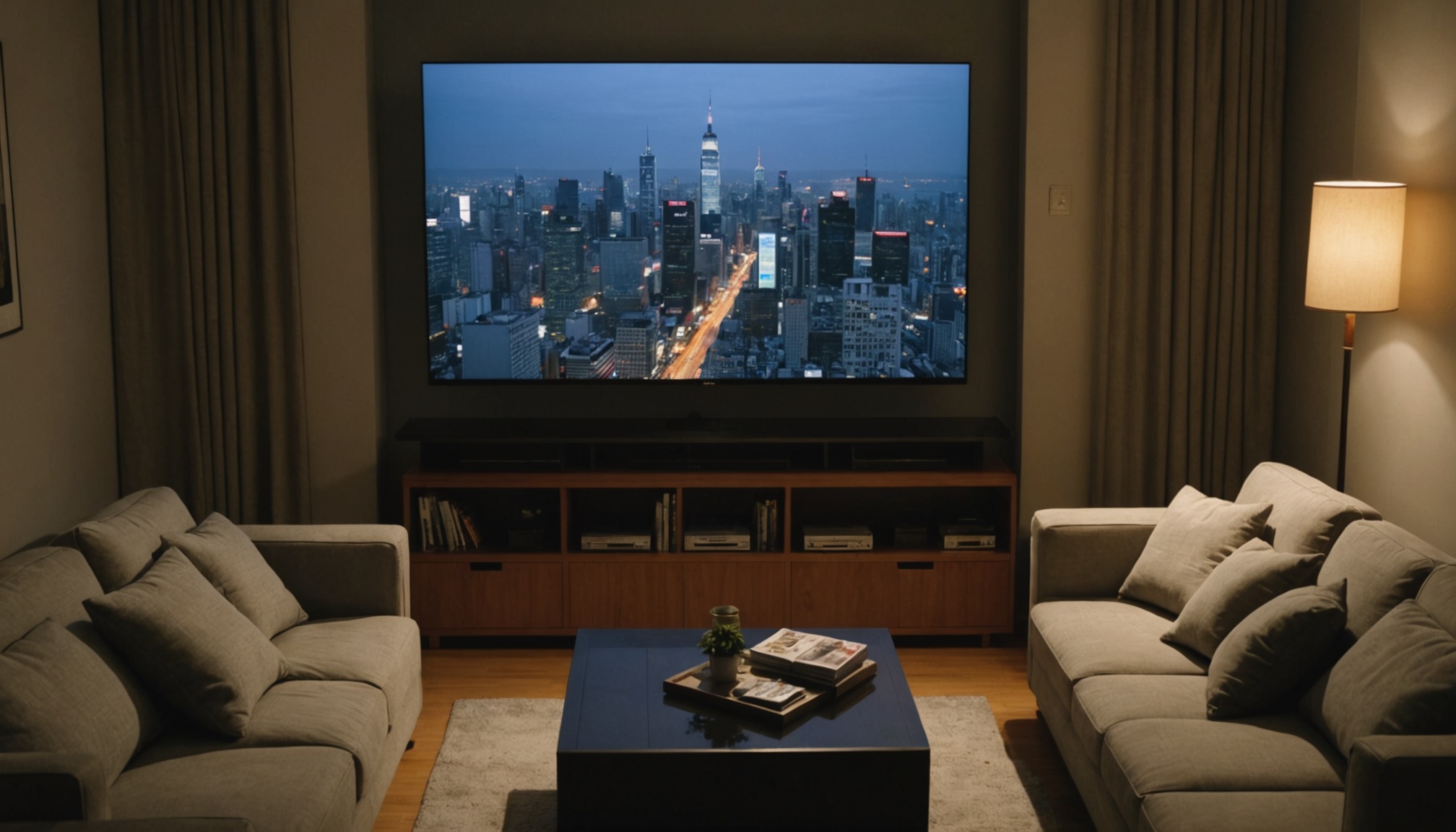
If your sofa sits 2.5 meters from the wall, the appropriate television is somewhere between 60 and 82 inches. The range is wide because there is more than one standard. The SMPTE recommendation, widely cited for film viewing, fills a 30-degree viewing angle; THX and the review site rtings use 40 degrees for an immersive setup (Optimum HDTV viewing distance).
For a 16:9 screen both angles collapse into simple multipliers: 30 degrees means diagonal × 1.63, and 40 degrees means diagonal × 1.20. Reverse them and you get size from distance — distance ÷ 1.63 for the relaxed size, distance ÷ 1.20 for the immersive one. A third line then crosses both: the distance at which individual pixels stop being visible.
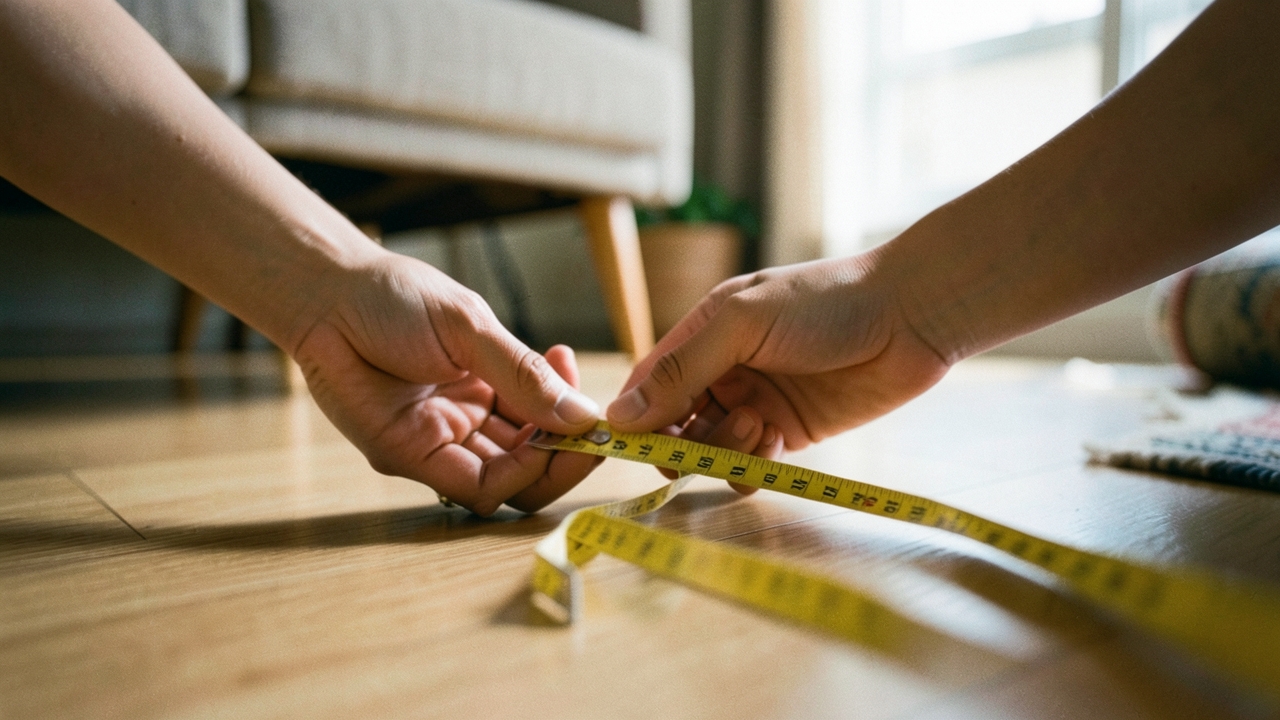
Working backwards from distance to inches
One piece of trigonometry does the work. The width of a 16:9 screen is 0.8716 times its diagonal, so the distance that fills an angle θ is (width ÷ 2) ÷ tan(θ/2). Feed in 30 degrees and you get 1.6265 × diagonal; 36 degrees gives 1.3413; 40 degrees gives 1.1973. These match Wikipedia's summary of the SMPTE guidance as "diagonal × 1.6264" and the THX guidance as "diagonal ÷ 0.84."
Applying those constants to real room measurements gives the table below, calculated directly from the formula.
| Viewing distance (cm) | 30° (inches) | 36° (inches) | 40° (inches) |
|---|---|---|---|
| 200 | 48.4 | 58.7 | 65.8 |
| 250 | 60.5 | 73.4 | 82.2 |
| 300 | 72.6 | 88.1 | 98.7 |
| 350 | 84.7 | 102.7 | 115.1 |
Korean apartment living rooms commonly measure 2.5 to 3.0 meters. At 30 degrees that points to 60–72 inches; at 40 degrees, to 82–98 inches. Sixty-five and 75 inches sit between the two lines. Neither is the wrong answer: the smaller end keeps subtitles and news comfortable, the larger end gives the screen your field of view.
How close must you be for 4K to be 4K?
Resolution draws its own line. Normal vision resolves about one arcminute, and on that basis a 4K screen must fill roughly a 58-degree angle before individual pixels become distinguishable. In screen heights, the optimum distance for 4K is 1.6 times the picture height — about 0.78 times the diagonal.
By size, that works out as follows. The third column is where pixels stop resolving; beyond it, 4K and well-upscaled content differ in processing rather than in pixel structure.
| Size (inches) | Width (cm) | 4K pixel-resolving limit (cm) | 40° distance (cm) | 30° distance (cm) |
|---|---|---|---|---|
| 43 | 95.2 | 85.7 | 130.7 | 177.6 |
| 50 | 110.7 | 99.6 | 152.0 | 206.6 |
| 55 | 121.8 | 109.6 | 167.2 | 227.2 |
| 65 | 143.9 | 129.5 | 197.6 | 268.5 |
| 75 | 166.0 | 149.4 | 228.0 | 309.8 |
| 85 | 188.2 | 169.4 | 258.4 | 351.1 |
For 65 inches that limit is 1.3 meters. Anyone watching from a sofa at 2.5 meters sits at twice the pixel-resolving distance, which is also why an 8K panel looks no sharper from that seat. Moving up in size, or moving the sofa closer, changes the experience more than moving up in resolution numbers.
Resolution exists only within a distance — past the limit, what remains is size and image processing.
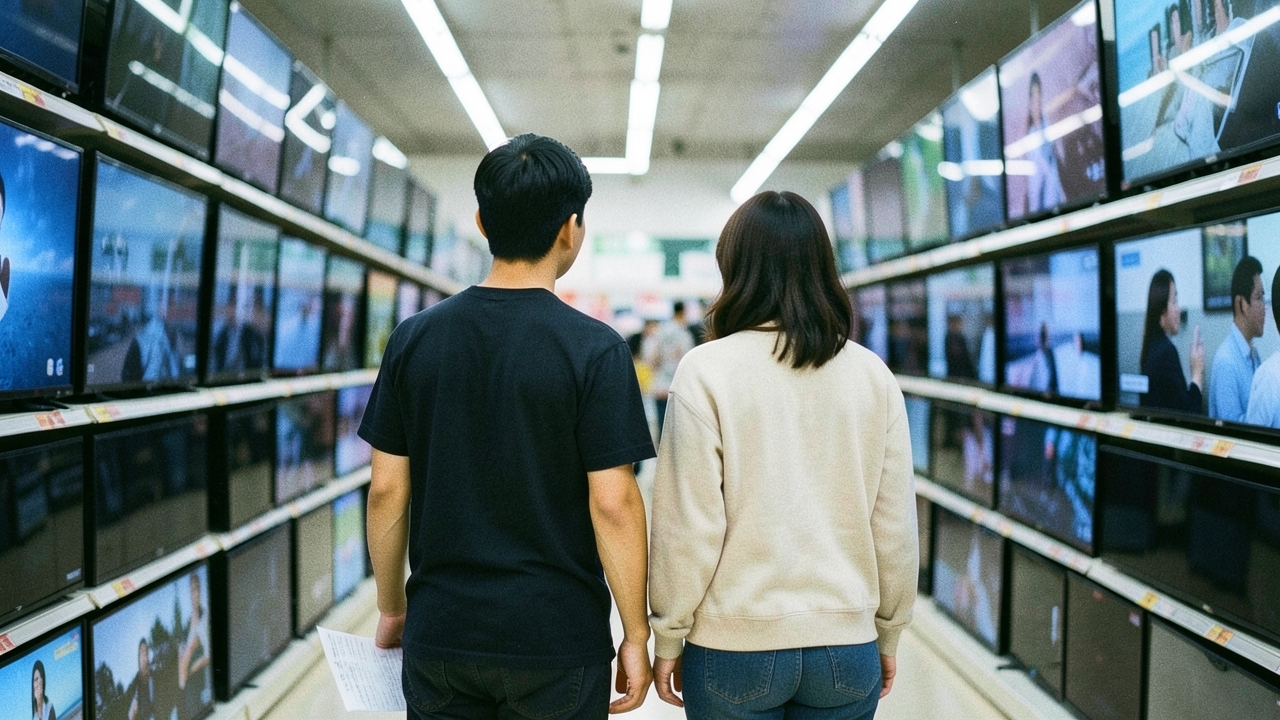
Why 65 inches has led for five straight years
In Danawa's Korean retail data, 65 inches has been the top-selling size every year from 2022 through 2026, holding 17.8% for January–May 2026, and the 55–70 inch band accounts for 32.5% of all sales (Danawa 2026 TV buying guide). Read against the table, that band matches 1.7–2.3 meters at the 40-degree standard and 2.3–3.0 meters at 30 degrees — precisely the spread of Korean living rooms.
The rise of 75 inches follows the same math. At 2.5 meters the 40-degree size is 82 inches, so 75 inches still sits inside the immersive line. Where the wall and the delivery path allow it, one size up from the same seat does not break the standard.
Panel technology is a separate axis. Two 65-inch sets can differ sharply in viewing angle and contrast, and a household that leaves bright static images on for long stretches has burn-in risk to weigh as well. Size first, panel second.
Check before ordering
- Measure from the sofa backrest to the mounting wall — eye-to-screen distance, not room length
- Choose between the two calculated values (÷1.63 and ÷1.20) by what you watch most: news and sport toward the smaller, film toward the larger
- Screen center height — mounting it far above seated eye level undoes the benefit of the calculated size
- VESA bracket spec, wall construction, and the position of power and antenna outlets
- Door and elevator width against the packed box — the real constraint above 75 inches
- If there is more than one seating position, calculate from the farthest one