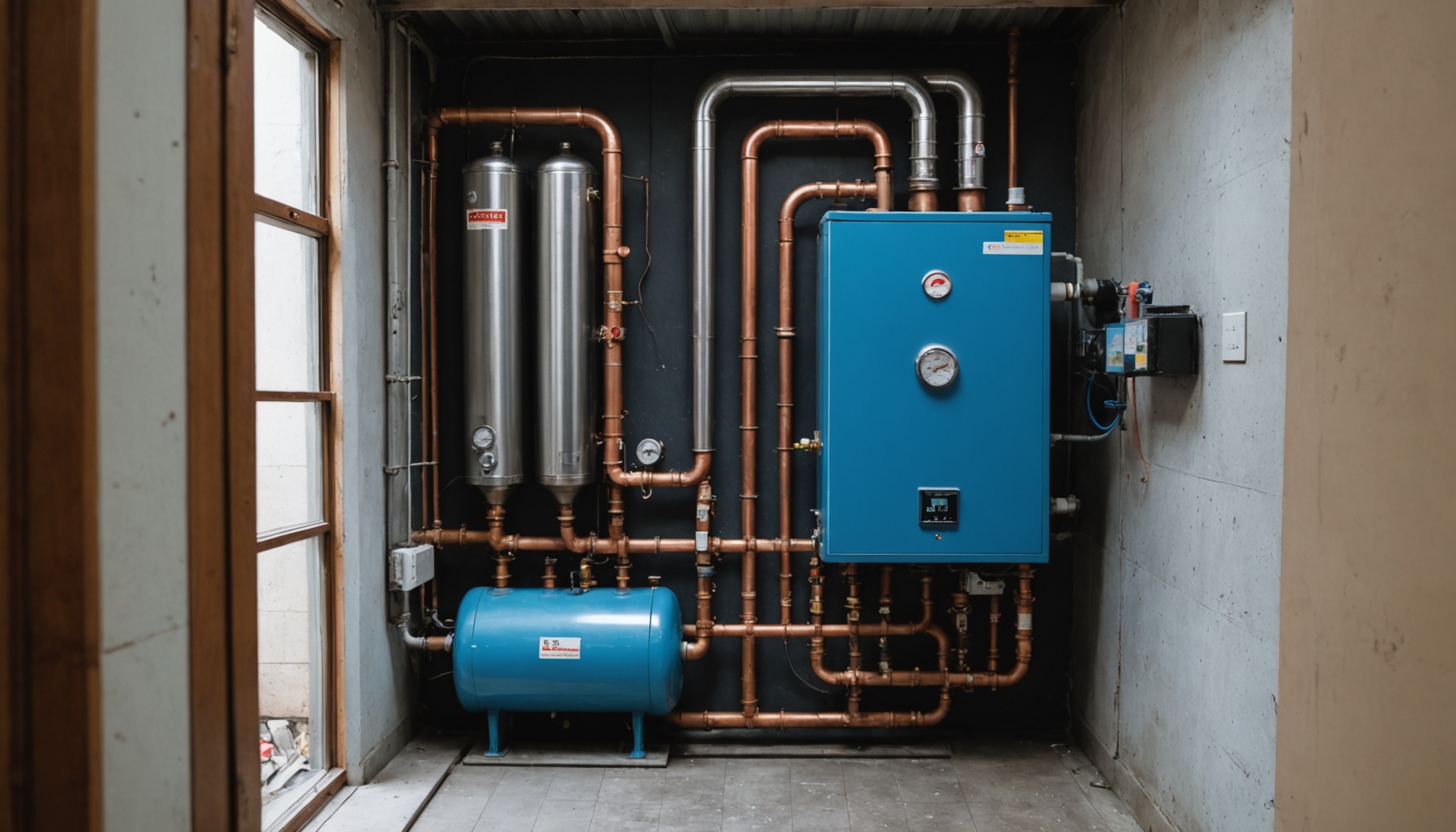
Delivering the same amount of heat costs 9.8% less in gas with a condensing boiler than with a standard one. That is the gap between 92% and 83% heating efficiency, converted at Seoul's city gas tariff.
Manufacturers advertise one number — efficiency. What a household actually pays is a gas bill. Between them sits a single division: the heat you need divided by efficiency gives the gas you burn, multiplied by the won-per-megajoule rate. Carry that through and something else falls out: a 9-percentage-point efficiency gap does not become a 9-point saving.
What separates 92% from 82%
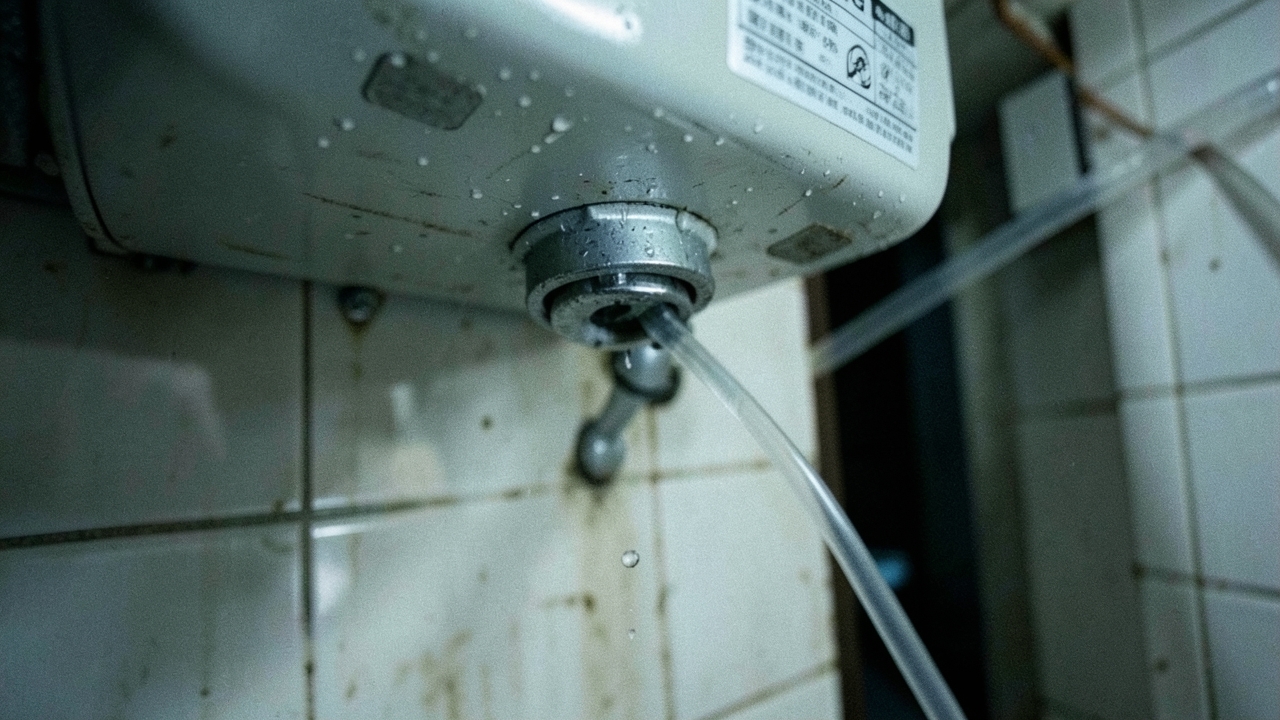
A standard gas boiler heats water with the flame and vents the combustion gases as they are. Those gases carry water vapour created during combustion, and the latent heat in that vapour goes up the flue. A condensing boiler adds a second heat exchanger, cools the exhaust below its dew point, and condenses that vapour back into liquid. The latent heat released in the process preheats the return water. That recovery is the whole of the efficiency difference.
Published specifications show the gap clearly. Per eNewsToday, condensing models from Korea's three largest makers list 92% or higher, with Kyungdong Navien's NCB760 and Kiturami's Geokkuro New Condensing rated at 94% or above and Rinnai Korea's RCM500 at 92% or above. Standard boilers built with low-NOx technology sit in the mid-80s. Nitrogen oxide output differs too: the same report cites up to 79% reduction for the NCB760 and roughly a quarter of conventional gas boiler output for Kiturami's units.
The labelling system draws the same line. Korea's Efficiency Management Equipment Operating Regulation covers household gas boilers, and the top grade requires 91% or better heating efficiency with standby power at or under 3W — effectively out of reach without condensing design. Converting an efficiency label back into an annual bill follows the same method used in reading washing machine efficiency grades as annual cost.
| Item | Standard boiler | Condensing boiler |
|---|---|---|
| Published heating efficiency | Mid-80s % | 92–94%+ |
| Heat exchangers | Primary only | Primary + condensing secondary |
| Flue latent heat recovery | None | Recovered by condensation |
| Condensate drain line | Not required | Required |
| Top efficiency grade (91%+) | Hard to reach | Core range |
| NOx reduction (as reported) | Baseline | Up to 79% lower |
How much the gas bill actually differs
Fix the tariff first. Per the Seoul City Gas rate table effective September 1, 2026, the residential rate for cooking and individual heating is 22.5268 won per MJ, with a monthly standing charge of 1,250 won. The standing charge does not vary with use, so it is excluded here.
Take 1,000 MJ of heat actually delivered indoors, and compute the gas burned and its cost at each efficiency: gas needed = 1,000 ÷ efficiency, cost = gas needed × 22.5268 won.
| Heating efficiency | Gas needed (MJ) | Cost (won) | Saving vs 82% (%) |
|---|---|---|---|
| 82% | 1,219.5 | 27,472 | — |
| 83% | 1,204.8 | 27,141 | 1.2 |
| 87% | 1,149.4 | 25,894 | 5.7 |
| 92% | 1,087.0 | 24,486 | 10.9 |
| 94% | 1,063.8 | 23,965 | 12.8 |
Compare 83% — the top of the standard range — with 92% at the bottom of the condensing range, and the bill falls 9.8%. Efficiency rose 9 percentage points; cost fell 9.8%. Because efficiency sits in the denominator, moving from 92% to 94% buys only another 2.1% off the bill. The return on chasing higher spec keeps shrinking.
Efficiency sits in the denominator — the two points from 92% to 94% are worth only 2.1% on the bill.
How many years to recover the price gap
Apply that ratio to a winter heating bill and a payback period appears. Start from what a household spends annually on heating gas with a standard boiler at 83%, and the condensing equivalent is that figure × 83 ÷ 92. This covers heating only, excluding cooking and hot water. Two price gaps are modelled: the roughly 200,000 won reported by eNewsToday, and 400,000 won for cases where installation work widens the difference.
| Annual heating gas bill, standard | Condensing equivalent | Annual saving | Payback at 200k gap | Payback at 400k gap |
|---|---|---|---|---|
| 400,000 won | 361,000 won | 39,000 won | 5.1 years | 10.2 years |
| 600,000 won | 541,000 won | 59,000 won | 3.4 years | 6.8 years |
| 800,000 won | 722,000 won | 78,000 won | 2.6 years | 5.1 years |
| 1,000,000 won | 902,000 won | 98,000 won | 2.0 years | 4.1 years |
| 1,400,000 won | 1,263,000 won | 137,000 won | 1.5 years | 2.9 years |
The less a home spends on heating, the slower the recovery. A small unit burning around 400,000 won a year takes five years to recoup a 200,000 won price gap, and more than ten if installation pushes the gap to 400,000. A larger home spending over a million won recovers it inside two years. That is why the replacement decision hinges on floor area and heating habits rather than on the spec sheet. The same efficiency-to-cost conversion applied to cooking appliances appears in induction versus radiant hob efficiency and electricity cost.
The government subsidy disappeared in 2026
One variable buyers often miss is the subsidy. Korea's Ministry of Environment had paid 100,000 won to ordinary households and up to 600,000 won to low-income households replacing an old standard boiler with a condensing model. According to Kyunghyang Shinmun, the 9 billion won budget for the household low-NOx boiler programme was cut entirely from the 2026 budget, with the money redirected to an air-source heat pump programme. Since the scheme began in 2017, 1.49 million boilers had been subsidised.
The same report notes that the replacement programme's air-source heat pumps cost up to 15 million won to install, against 1 to 2 million won for an eco-friendly boiler, and that the legal basis for support is still being worked out. In practice, a household replacing a boiler in 2026 pays the full equipment cost with no national subsidy — which pushes reality toward the 400,000 won column in the payback table above.
- Published heating efficiency of 92–94%, cutting gas cost per unit of heat by 9.8–12.8%
- Sits in the top efficiency grade band (91% or higher)
- Nitrogen oxide output listed as up to 79% lower
- A condensate drain is mandatory, so installations without a floor gully need extra plumbing
- Equipment costs roughly 200,000 won more, with no national subsidy from 2026
- Payback stretches past five years in smaller homes with low heating bills
Who this suits, and who should wait
Judging on published specs and tariffs alone, the decision reduces to three cases.
- Replace now — annual heating gas above 800,000 won, an existing condensate drain at the boiler location, and a unit more than ten years old. The price gap clears in two to three years.
- Re-run the numbers — a small home spending around 400,000 won a year, or a quote where new condensate plumbing widens the gap beyond 400,000 won. Payback stretches to five or ten years, overlapping the equipment's own service life.
- Wait — the current boiler runs without fault and a move is planned within three years, in which case the savings accrue to the next occupant.
Four things to confirm before taking a quote. First, whether the catalogue efficiency figure is for heating or hot water. Second, the grade and standby power on the energy efficiency label. Third, whether the installation point has a condensate drain and what new plumbing would cost. Fourth, whether your local government has posted its own replacement subsidy despite the national cut — that varies by district, so check the municipal environment office notice directly.