A heat-pump clothes dryer uses roughly 1 kWh per cycle, which works out to about 250 won of electricity. You cannot get that number from rated power draw. The wattage on the spec sheet is the instantaneous figure with the compressor and heater running flat out, whereas a real cycle spends most of its time with the compressor switching on and off after the drum reaches temperature. The number that belongs in a cost calculation is energy consumption per standard cycle, not rated power.
More to the point, that figure varies widely between models. When the Korea Consumer Agency measured seven heat-pump dryers of the same class on their standard programs, energy per cycle ranged from 958 Wh to 1,593 Wh at half load and from 1,576 Wh to 2,442 Wh at full load. Same drying method, same capacity — and a 1.5 to 1.7 times spread in running cost.
Why rated power gives the wrong answer
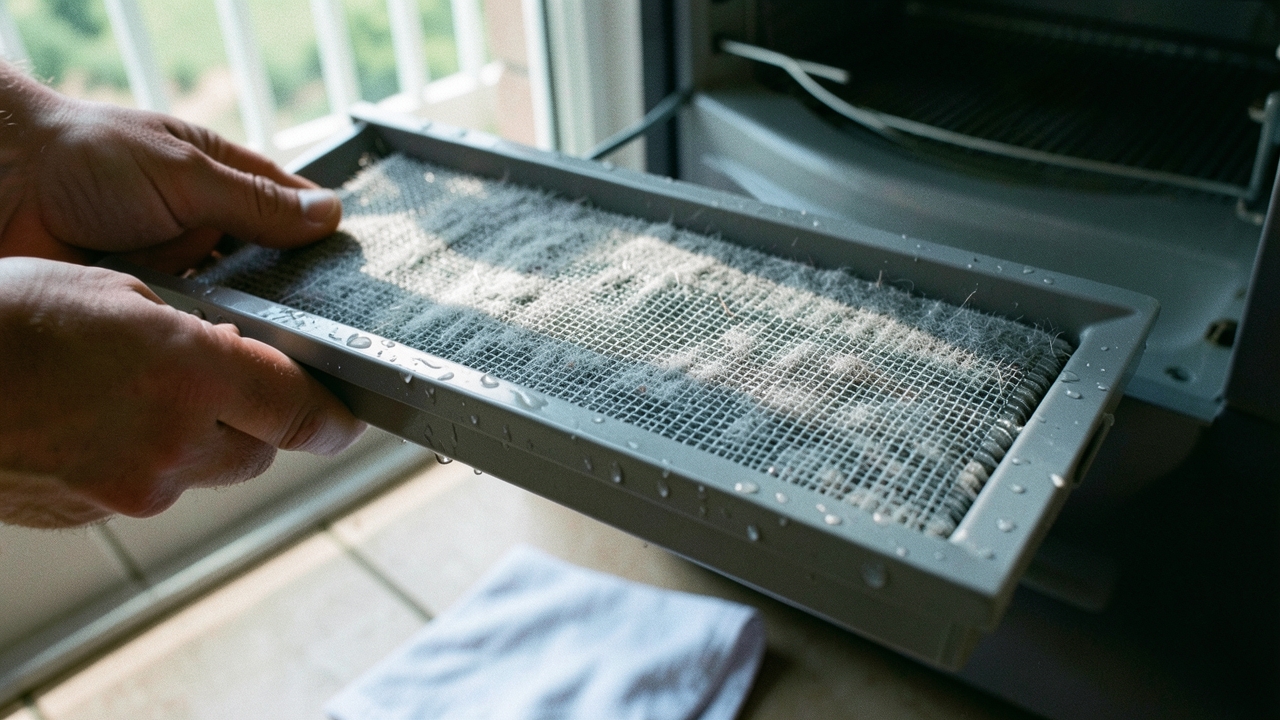
A heat-pump dryer warms air to pull moisture out of fabric, then cools the humid air over an evaporator to condense the water out before reheating and recirculating it. Because heat is recovered rather than vented away, energy per cycle is low. But the compressor throttles back or stops once the target temperature is reached, so rated power never flows for the full three hours.
The size of the error is easy to see. Assume a 900 W model running three hours and you get 2.7 kWh; the measured value at half load is around 1 kWh. You would overestimate by two to three times. Vented and resistive-heater dryers are different — the element draws close to rated power whenever it is on, so a rated-power estimate lands closer to reality. Apply one method to both types and the comparison between them breaks down.
That is why the energy efficiency label is the right starting point. As Energy News reports, dryers with rated power of 3,000 W or less were designated for mandatory efficiency-grade labeling, requiring manufacturers and importers to file accredited test-lab measurements with the Korea Energy Agency. The scope covers rotary dryers with standard drying capacity from 1 kg to 20 kg, including both vented and condenser types. In other words, heat-pump and heater models alike carry a per-cycle figure measured by the same test method, and those figures are directly comparable.
Why identical 10 kg heat-pump models differ by 1.7 times
The Korea Consumer Agency comparison relayed by Korea.kr tested seven 9–10 kg heat-pump dryers for safety, dryness, cycle time, energy use, and noise. No model had a safety defect, but the performance figures diverged.
| Measured item | Half load | Full load |
|---|---|---|
| Energy per cycle (Wh) | 958 – 1,593 | 1,576 – 2,442 |
| Spread between models | up to 1.7× | up to 1.5× |
| Largest cycle-time gap | 58 minutes | 33 minutes |
| Largest annual cost gap | 22,000 won | 29,000 won |
The revealing detail is that cycle time and energy use do not move together. The slowest model at half load took 2 hours 42 minutes, while the fastest at full load finished in 2 hours 59 minutes — and that fast model was rated insufficient, at 91% dryness. A cycle that ends with laundry still damp also records a low energy figure. Choose on energy alone and you can mistake an under-drying machine for an efficient one.
So the per-cycle figure on the label is a number that only means something paired with dryness. The real efficiency gap is the energy difference between models that both cleared 100% dryness under the same conditions.
A lower energy figure does not mean a more efficient machine. A machine that quits before the laundry is dry also posts a low figure.
Working out the cost of one cycle
The rate to multiply by is not an average but the marginal rate of the tier your household has already reached. Residential electricity in Korea is progressively tiered, so every additional kWh is billed at the highest tier you have entered. Per the Korea Electric Power Corporation low-voltage residential schedule, the energy charge is 120 won in tier one, 214.6 won in tier two, and 307.3 won in tier three, plus a climate-environment charge of 9 won and a fuel-cost adjustment of 5 won per kWh. On that sum sit 10% VAT and a 3.2% electricity industry fund levy, producing the true marginal rate.
That comes to 151.7 won, 258.8 won, and 363.7 won respectively. Tier boundaries are 300 and 450 kWh in summer (July–August) and 200 and 400 kWh in other months. Applying those rates to the measured range gives the table below.
| Energy per cycle (kWh) | At 151.7 won (won) | At 258.8 won (won) | At 363.7 won (won) |
|---|---|---|---|
| 0.96 (half-load minimum) | 146 | 248 | 349 |
| 1.20 | 182 | 311 | 436 |
| 1.59 (half-load maximum) | 241 | 411 | 578 |
| 2.44 (full-load maximum) | 370 | 631 | 887 |
A few hundred won per cycle sounds trivial, but the annual total reads differently. At three cycles a week — 156 a year — and the tier-two rate:
| Energy per cycle (kWh) | Annual energy (kWh) | Annual cost at tier 2 (won) | Annual cost at tier 3 (won) |
|---|---|---|---|
| 0.96 | 150 | 38,758 | 54,468 |
| 1.20 | 187 | 48,447 | 68,085 |
| 1.59 | 248 | 64,193 | 90,212 |
| 2.44 | 381 | 98,510 | 138,439 |
The gap between the half-load minimum and the full-load maximum is roughly 60,000 won a year at tier two. And there is a subtler trap: the 150–380 kWh a dryer adds each year can itself push you into a higher tier. A household using 190 kWh a month that adds 20 kWh of drying crosses into tier two, and the excess of its existing consumption is then billed at the higher rate too. It is the same mechanism laid out in the marginal-rate math for electric blankets and water mats.
Capacity or efficiency grade — which moves the bill more?
Look again at the table: a 1.59 kWh half-load cycle and a 1.58 kWh full-load cycle cost the same. What drives the bill is not the capacity on the box but how much goes in per load and how many loads you run. Putting 5 kg into a 10 kg drum twice means two half-load cycles at 1.9–3.2 kWh; consolidating into one full load finishes at 1.6–2.4 kWh. Sizing up and running fewer cycles wins on the arithmetic.
The counterweight is that larger machines cost more and demand more installation space. With an annual difference around 60,000 won, a payback calculation is worth doing. The same method applied to running costs by technology type appears in the annual running-cost comparison of humidifier types.
Who this suits, and who can wait
- Households running three or more cycles a week — the annual difference compounds, so comparing per-cycle figures across models is worth the effort. Two models with the same grade can still post different numbers
- Households near a tier boundary — around 190 or 390 kWh a month, adding a dryer alone can lift your marginal rate by over 100 won. Use the tier-three column
- Anyone planning to install on an unheated balcony — a heat pump recovers heat from surrounding air, so cold ambient conditions change the equation. Check the manufacturer's stated operating temperature range
- Households running one cycle a week or less — the annual gap shrinks below 20,000 won. Dryness and noise ratings deserve priority over running cost
- Owners of pre-labeling models — with no label figure there is no basis for comparison. Measuring actual consumption with a plug-in power meter and dropping it into the table is the remaining option