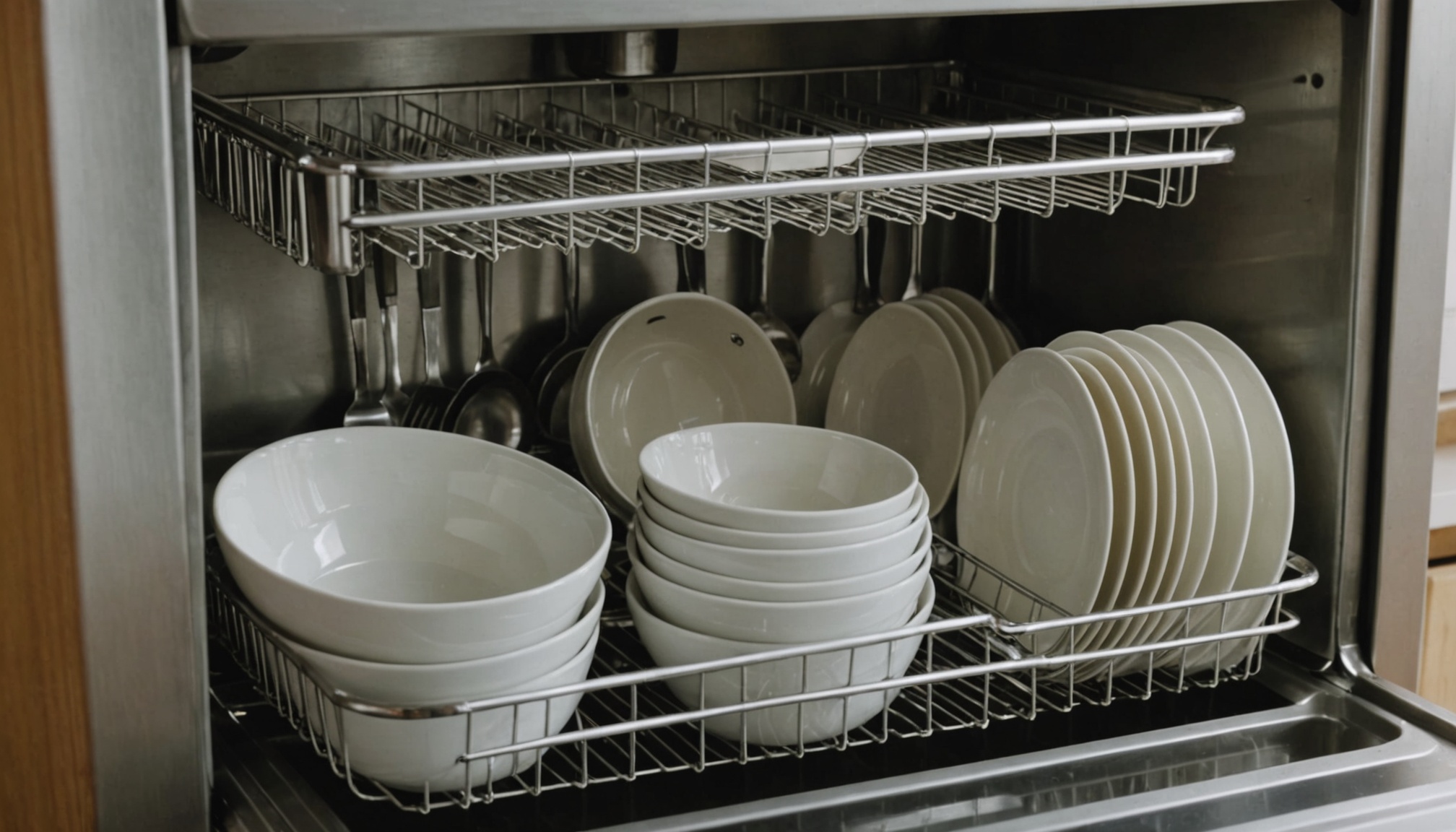
A dishwasher's electricity use per cycle runs 0.68kWh on a six-setting countertop model and 0.97kWh on a twelve-setting built-in. Yet a current fourteen-setting built-in draws 0.6081kWh — less than the six-setting unit. Place settings count how many stacks of dishes fit inside; they are a different axis from how much power the machine burns.
Apply the marginal residential tariff at the second progressive tier and one cycle costs 176 won on the six-setting model, 251 won on the twelve, and 157 won on the fourteen. What it costs to wash the same plates is set by how the water is heated and how recent the model is, not by capacity.
Divide published specifications and the dishwasher filings in the Korea Energy Agency's efficiency management registry down to a per-setting basis, and a band opens up that the capacity label never shows.
Where six settings burn more than fourteen
Three models placed side by side on published manufacturer specifications. The per-setting rows are calculated directly by dividing the per-cycle figure by washing capacity.
| Item | 6-setting countertop | 12-setting built-in | 14-setting built-in (current) |
|---|---|---|---|
| Electricity per cycle (kWh) | 0.68 | 0.97 | 0.6081 |
| Water per cycle (L) | 8.7 | 14 | not published |
| Rated power (W) | 1,170 | 1,760 | not published |
| Electricity per setting (Wh) | 113.3 | 80.8 | 43.4 |
| Water per setting (L) | 1.45 | 1.17 | not published |
| Energy efficiency grade | not rated | not rated | Grade 1 |
| W×H×D (mm) | 555×450×500 | 598×845×600 | 600×815×- |
Per-setting consumption spreads 2.6-fold, from 113.3Wh down to 43.4Wh. Heating the wash chamber once does not scale down with the number of dishes. The energy spent bringing water up to temperature and holding the chamber warm is close to a fixed cost regardless of size, and the six-setting machine spreads that cost over only six settings.
The fourteen-setting unit undercuts the six-setting one in absolute terms because of generation, not capacity. It carries controls that vary water volume, temperature and spray pressure by soil level, and it holds a Grade 1 efficiency rating. The place-setting number on the label describes storage; consumption per cycle grades the heating and water-metering control. The same confusion recurs in the units used for cordless vacuum suction.
The six-setting machine uses 12% more electricity per cycle than the fourteen-setting one. Place settings count stacks of dishes; they do not rank power consumption.
Why the six-setting model carries no efficiency grade
Dishwashers came under Korea's energy efficiency grading scheme in July 2024. Grades 1 to 5 were newly defined for household units of 20 settings or fewer, together with an obligation to file a grade and display the label. The number of managed product categories rose from 34 to 40 at the same time, taking in portable air conditioners and large-capacity clothes dryers.
The complication is models released before that date. On their product pages, both the six-setting and twelve-setting units above show the efficiency grade field as "not rated," and only the 2025 fourteen-setting model carries Grade 1. On a showroom floor, labelled and unlabelled products sit together, and the unlabelled ones cannot be compared by grade at all. In that case the only common field left is electricity per cycle.
The agency's registry holds 162 filed dishwasher models. Filed per-cycle consumption spans roughly 388Wh to 1,029.6Wh, with washing capacity running from 3 to 15 settings — a 2.65-fold spread between the extremes. For an unlabelled model, the useful question is where inside that band it falls: near 388Wh is the top of the range, above 1,000Wh the bottom.
What assumption produces the 36,000-won annual energy cost
The fourteen-setting model's product page lists 608.1Wh per cycle alongside an annual energy cost of 36,000 won. Working backwards from that figure exposes the premise underneath it.
Assume one cycle a day, or 365 a year, and annual consumption is 0.6081 × 365 = 221.96kWh. Dividing 36,000 won by 221.96kWh gives roughly 162 won per kWh. Neither the assumed cycle count nor the applied tariff is published, so that 162 won is a derived figure resting on the one-cycle-a-day assumption.
The rate actually borne is higher. In KEPCO's low-voltage residential tariff, the energy charge is 120 won at tier one, 214.6 won at tier two and 307.3 won at tier three, with a climate-environment charge of 9 won per kWh and a fuel-cost adjustment of 5 won per kWh on top. Adding 10% VAT and the 3.2% electricity industry fund brings the effective marginal rate to 151.7, 258.8 and 363.7 won respectively.
Multiplying the same 221.96kWh by 258.8 won gives 57,400 won — 1.59 times the label's 36,000 won. The label figure is a reference value for comparing models; what lands on the bill is set by whichever progressive tier the household has already reached. The same marginal-rate calculation applied to clothes dryers is set out in the piece on dryer running costs.
Water costs a fifteenth of what electricity does
Water saving is the argument most often made for dishwashers, yet converted into money it barely registers. Seoul charges 580 won per cubic metre for household tap water, 170 won as a water-use levy applied regardless of category, and 480 won for sewerage under the 2026 schedule. Together that is 1,230 won per cubic metre, or 1.23 won per litre.
| Item | 6-setting (0.68kWh / 8.7L) | 12-setting (0.97kWh / 14L) | 14-setting (0.6081kWh) |
|---|---|---|---|
| Electricity per cycle (won) | 176 | 251 | 157 |
| Water and sewerage per cycle (won) | 11 | 17 | not published |
| Total per cycle (won) | 187 | 268 | 157 or more |
| Electricity, 260 cycles a year (won) | 45,800 | 65,300 | 40,900 |
| Water, 260 cycles a year (won) | 2,800 | 4,500 | not published |
| Total, 260 cycles a year (won) | 48,600 | 69,800 | 40,900 or more |
Electricity is priced at the tier-two marginal rate of 258.8 won, and usage is set at 260 cycles a year, equivalent to five a week. The twelve-setting model takes 5.3 litres more water per cycle, and that difference costs 7 won. The electricity difference is 75 won, more than ten times as much. Annualised, water diverges by 1,700 won and electricity by 19,500 won.
Water use is therefore not really a variable when choosing capacity; consumption per cycle and the number of cycles actually run decide the bill. Choose a six-setting model and run it twice a day and you reach 0.68 × 2 = 1.36kWh, above the 0.97kWh of a twelve-setting model run once. How thermal efficiency inverts running costs follows the same structure as the induction versus radiant hob calculation.
Who the six-setting model suits
- Anyone who must sit the machine on a worktop and cannot run supply and drain plumbing — the six-setting countertop is 555mm wide and 450mm tall, so it fits under wall cabinets. The twelve-setting unit is 598mm wide and 845mm tall and needs a base cabinet cleared for it
- Households of two or fewer running one cycle a day or less — if the cycle count does not climb, 0.68kWh per cycle stays the ceiling
- Anyone not planning to load pots and pans — a six-setting chamber 500mm deep will not take large cookware
If you expect to run two or more cycles a day, or intend to load cookware, the larger machines with lower per-setting consumption also come out ahead on running cost. Among labelled models, filtering first for per-cycle consumption near the bottom of the filed range — the 400Wh band — is more precise than reading the grade number alone.
Sources
- BESPOKE countertop dishwasher, 6 settings, DW30A3030CE specifications (Samsung Electronics)
- BESPOKE dishwasher, 12 settings, DW60T8075FG specifications (Samsung Electronics)
- Bespoke AI built-in dishwasher, 14 settings, DW90F79P1U01S specifications (Samsung Electronics)
- Efficiency grading extended to 11 categories including dishwashers (Korea Policy Briefing)
- Filed dishwasher energy efficiency grade data (Korea Energy Agency efficiency management system)
- Residential electricity tariff schedule (KEPCO)
- Tariff schedule by usage category (Seoul Arisu customer centre)