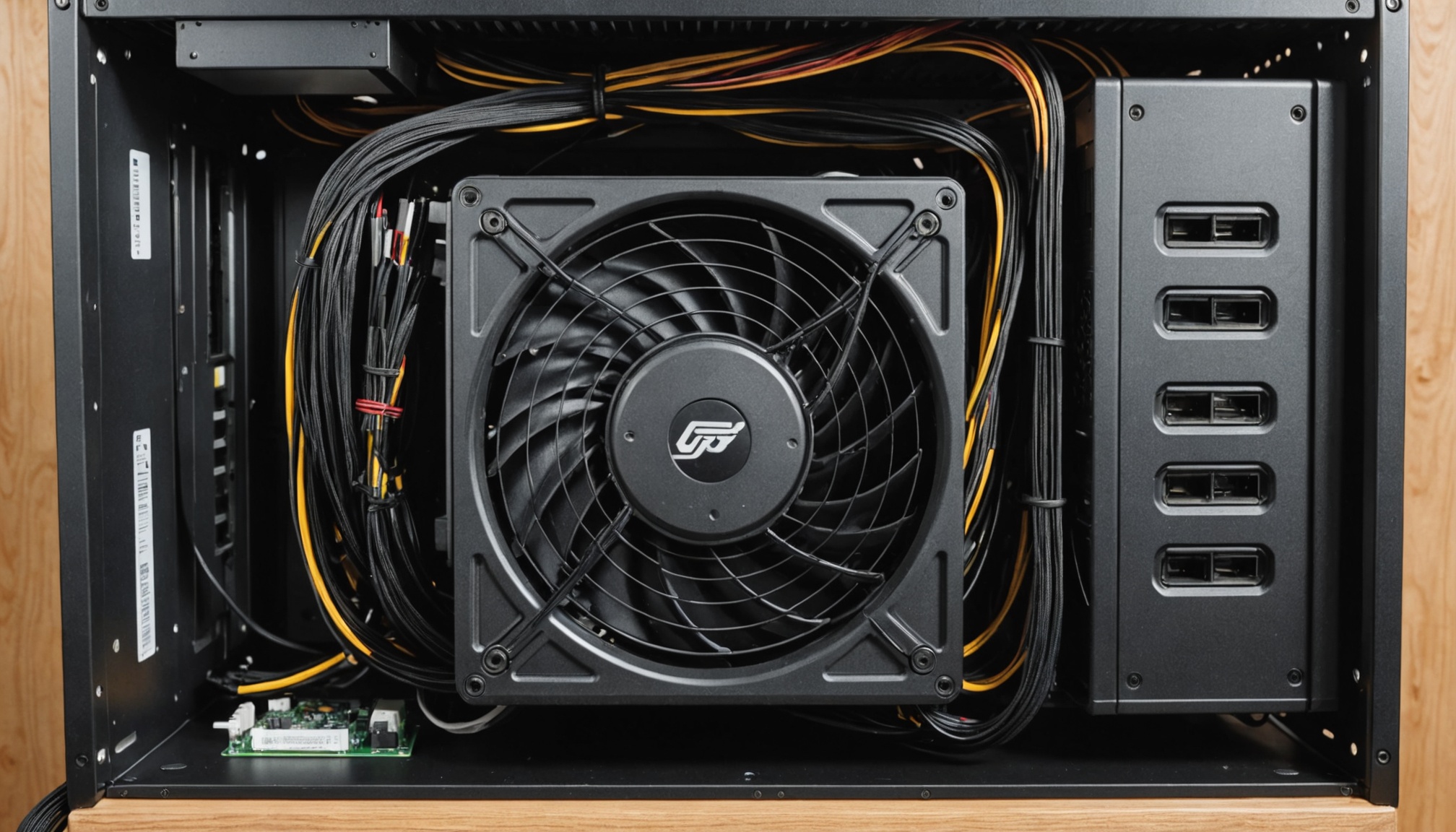
A power supply's rated wattage falls out of the real load — GPU TGP plus CPU peak power — divided by a target load ratio. On the specs compiled by TechPowerUp, the RTX 5090 sits at 575W and the RTX 5080 at 360W; add the Core Ultra 9 285K's 250W maximum turbo power and you get 825W and 610W.
Budget 80W for everything else and the real load becomes 905W and 690W. Divide by 0.6 and you land on 1,508W and 1,150W; divide by 0.8 and you get 1,131W and 863W. Nvidia's own recommendations are 1,000W and 850W. Why the calculated figure and the recommended figure sit that far apart is the real question behind picking a wattage.
Rated wattage comes from three numbers
Only three values matter: the graphics card's TGP, the CPU's peak power, and the sum of everything else. The first two account for more than 80% of the total, so getting them wrong makes precision elsewhere pointless.
The CPU figure is published two ways, which is where mistakes creep in. On Intel's product specification page, the Core Ultra 9 285K lists Processor Base Power at 125W and Maximum Turbo Power at 250W — a factor of two apart. The "125W" often shown by retailers is the first number, so building on it understates the real load by 125W. For how the tiers differ in power envelope, see how to read Core Ultra 5, 7 and 9 tier labels.
For the remainder — motherboard, memory, storage, fans, pump — 60 to 100W is the usual estimate on published component specs. The table below fixes that at 80W and works out the real load and required rating for each combination.
| Build | GPU TGP (W) | CPU peak (W) | Rest (W) | Real load (W) | Rating at 60% load (W) | Rating at 80% load (W) | Vendor recommendation (W) |
|---|---|---|---|---|---|---|---|
| RTX 5090 + Core Ultra 9 285K | 575 | 250 | 80 | 905 | 1,508 | 1,131 | 1,000 |
| RTX 5080 + Core Ultra 9 285K | 360 | 250 | 80 | 690 | 1,150 | 863 | 850 |
| RTX 5080 + 285K (using 125W base power) | 360 | 125 | 80 | 565 | 942 | 706 | 850 |
The third row is the trap described above. Same hardware, but plugging in base power instead of turbo power concludes that 706W is plenty. In practice there are moments when both parts hit their ceiling together, and for those moments the first two rows are the relevant ones.
Vendor says 850W, the math says 1,150W — which is right?
Both, because they answer different questions. Nvidia's 850W for the 5080 and 1,000W for the 5090, as summarised by Digital Trends, is a safe floor. The 1,150W and 1,508W from the 60%-load calculation place the real load in the most efficient part of the curve.
The vendor number draws a line you must not go under; the load-ratio math answers a different question — where the unit sits most comfortably.
Practically, the answer lives between them. For an RTX 5080 build, somewhere between 863W (80% load) and 1,150W (60% load) — so the 850 to 1,000W band — is reasonable; for an RTX 5090 build, 1,200W is the first candidate inside the 1,131 to 1,500W range. Sitting right on the floor means the fan spends longer at high RPM; going to the top of the range buys headroom at the cost of price and bulk.
What ATX 3.1 guarantees beyond the rating
Two units with the same rating can differ sharply in how they absorb transients. Intel's ATX design guide specifies power excursion by duration, and units rated above 450W with a 12V-2x6 connector face a much higher bar.
| Duration | Rated ≤450W, no 12V-2x6 | Rated >450W with 12V-2x6 | Test duty cycle |
|---|---|---|---|
| 100µs | 150% | 200% | 5% |
| 1ms | 145% | 180% | 8% |
| 10ms | 135% | 160% | 12.5% |
| 100ms | 110% | 120% | 25% |
| Sustained | 100% | 100% | — |
The 200%-for-100-microseconds clause is the important one: a 1,000W unit has to ride out a momentary push to 2,000W without its protection circuit cutting the system. Current high-end graphics cards generate spikes well above their TGP when load changes abruptly, and a unit with generous rating but poor transient response shows this as an abrupt reboot mid-game.
The difference between ATX 3.0 and 3.1 lies in refining those excursion rules and updating the connector from 12VHPWR to 12V-2x6. For a new build, a 3.1 label is the baseline; if a 3.0 unit is already installed, checking its rating and connector shape comes first.

80 PLUS tiers, converted into watts
Efficiency certification is a separate axis from capacity. Per Seasonic's summary of the certification and the tier specifications, at 50% load a unit must reach 85% for Bronze, 88% Silver, 90% Gold, 92% Platinum and 94% Titanium. That the tiers are benchmarked at 50% load is exactly why the load-ratio math above aimed around 60%.
Converting the efficiency gap into consumption makes it tangible. The table fixes output at 600W — the 50% load point of a 1,200W unit — and works out wall draw plus consumption over 30 days at four hours a day.
| Tier | Efficiency at 50% load (%) | Input at 600W output (W) | 30 days at 4h/day (kWh) | Saving vs Bronze (kWh) |
|---|---|---|---|---|
| Bronze | 85 | 706 | 84.7 | — |
| Silver | 88 | 682 | 81.8 | 2.9 |
| Gold | 90 | 667 | 80.0 | 4.7 |
| Platinum | 92 | 652 | 78.3 | 6.4 |
| Titanium | 94 | 638 | 76.6 | 8.1 |
Bronze to Titanium is a gap of 8.1kWh a month. Whatever tariff you assume, two tiers of certification will not pay themselves back quickly. The real payoff sits not in the bill but in how much wasted power turns into heat. Where Bronze dumps 106W as heat, Gold dumps 67W and Titanium 38W. Less heat means lower fan speed, and lower noise with it.

Which rating fits, and when to leave it alone
On published specifications, the choice comes down to three cases.
- RTX 5090 class with a high-end CPU — 905W real load. A 1,200W rating, ATX 3.1, and a dedicated 12V-2x6 cable. The 1,000W floor works, but load ratio hovers above 90%
- RTX 5080 class with a high-end CPU — 690W real load. An 850 to 1,000W rating with ATX 3.1; Gold or better pays off in heat and noise
- Mid-range GPU with a 6- to 8-core CPU — roughly 400W real load. 650 to 750W is ample, and if no 12V-2x6 is needed an ATX 3.0 unit is fine
There are equally clear cases for not replacing anything. With no GPU upgrade planned and a real load under 70% of the current rating, swapping purely for a higher tier pays back slowly on the conversion table above. The reverse also holds: with a GPU generation change coming, settle the power supply first. It is the longest-lived part inside the case, and unlike storage — where matching the interface lets you add a drive later — replacing it afterwards means redoing every cable run from scratch.

References
- NVIDIA GeForce RTX 5090 Features 575 W TDP, RTX 5080 Carries 360 W TDP — TechPowerUp
- Intel Core Ultra 9 Processor 285K product specifications — Intel
- PSU Power Excursion — ATX Version 3.0 Desktop Platform Power Supply Design Guide, Intel
- What Does 80 PLUS Mean? Why Efficiency is Important for PSU? — Seasonic
- What power supply do you need for the RTX 5090 and RTX 5080? — Digital Trends