
Buy a washer and dryer separately, or go with an all-in-one unit that combines both? This question resurfaces every summer when home appliance demand spikes. According to The Korea Economic Daily (Hankyung), with ongoing extreme heat driving a surge in summer appliance orders, some products sell steadily even at prices above KRW 800,000. The more functions are concentrated in one device, the greater the trade-offs the buyer must accept. Here is a head-on comparison of all-in-one and separate units, focused on specs and cost structure.
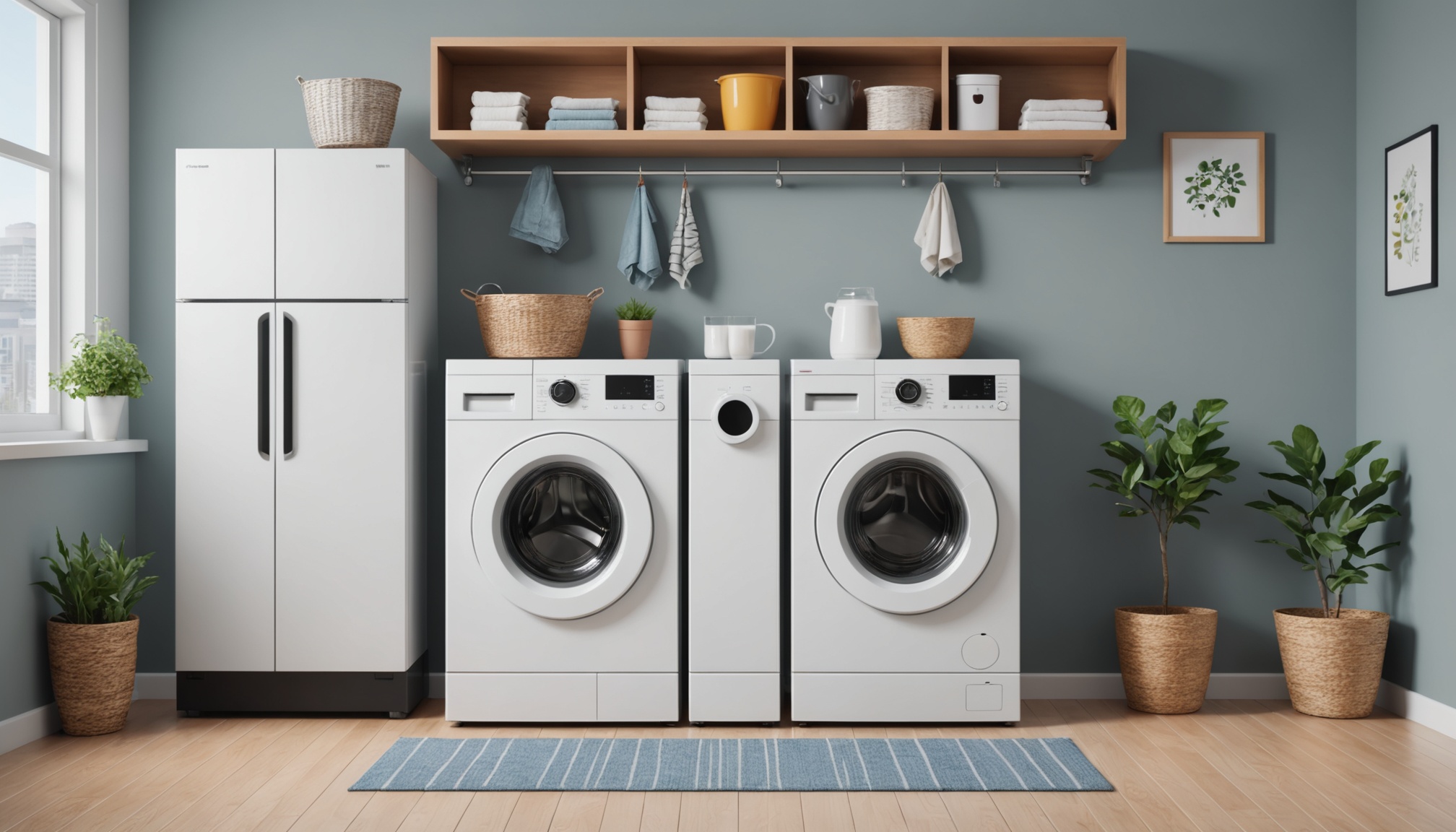
What Is an All-in-One Washer-Dryer?
An all-in-one washer-dryer (also known as a combo unit) performs both washing and drying in a single drum. Since there is physically only one drum, the installation footprint is equivalent to a single standard washing machine. For homes that cannot fit two appliances side by side — such as a corner of a bathroom or a narrow balcony — this may be the only realistic option. That is why demand remains consistently high in urban compact apartments and studio apartments where total floor space is inherently limited.
Structurally, an all-in-one unit runs a drying cycle in the same drum after washing is complete. Moisture is removed from inside the drum using condensation or heat pump methods. This eliminates the need for a dedicated exhaust duct, allowing installation in indoor environments with limited ventilation. However, the core constraint is that the washing capacity and drying capacity are different. Based on publicly disclosed specs, many products offer drying capacity at only 50–65% of the washing capacity. This means that after filling the drum to run a full wash load, you may need to remove some laundry before the drying cycle begins.
Time is also a real issue. Running washing and then drying in the same unit consecutively typically takes 3–4 hours or more per cycle. Unlike a separate setup where you can run the dryer in parallel the moment washing finishes, sequential processing is unavoidable. This is the primary reason all-in-one units feel inconvenient for households of four or more with frequent laundry loads.
Spec Advantages and Cost Structure of Separate Units
Separate units operate a washer and dryer as independent appliances. Each device is optimized purely for its function, giving broader options for capacity, performance, and wash program variety compared to all-in-one units. The washer can run simultaneously with the dryer, reducing total housework time. Large-capacity drum dryers uniformly distribute and dry laundry, resulting in fewer wrinkles and a softer finish — a commonly cited advantage in manufacturer announcements across the category.
The cost structure is complex. On initial purchase cost alone, separate units require the price of one washer plus the price of one dryer, making upfront spending higher than an all-in-one. However, a different calculation emerges over the long term. An all-in-one unit integrates both the wash motor and the drying heater (or heat pump) into a single body — if either function fails, the entire unit requires repair or replacement. With separate units, if the washer breaks down, the dryer continues to work, and partial upgrades — replacing just one unit as technology advances — are possible. Looking at total cost of ownership (TCO) over a 5–10 year product lifespan, separate units can come out ahead.
Installation space is the biggest weakness of separate units. Side-by-side parallel installation requires at least 120cm of horizontal clearance, and stacked installation can reach 170–185cm in height — ceiling clearance and the load capacity of the installation structure must be verified in advance. Stacking kits often need to be purchased separately, adding to the cost.
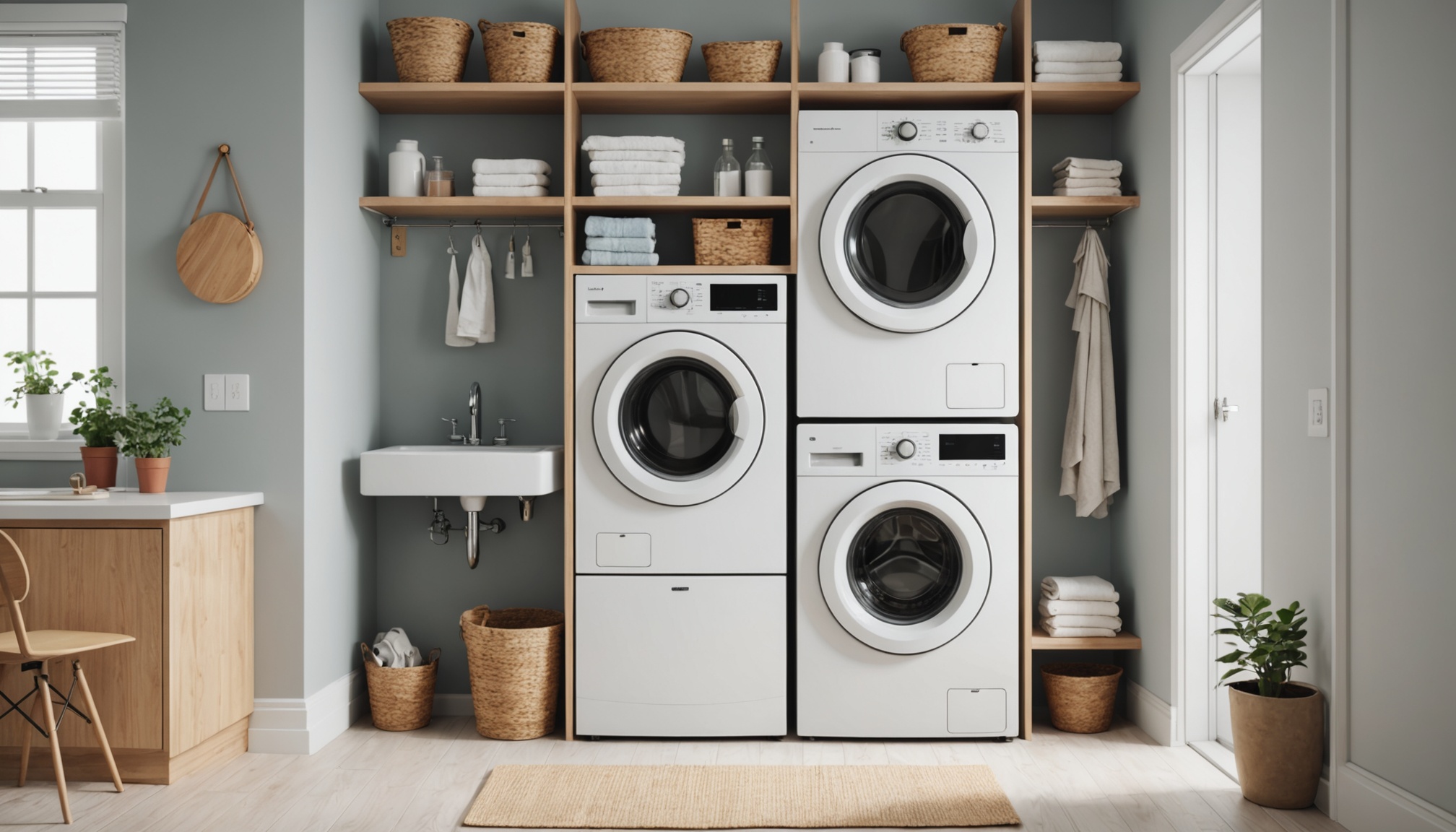
Buying all-in-one means buying space; buying separate units means buying performance and flexibility — the two options differ not in feature superiority but in the trade-off between usage environment and cost structure.
Core Spec Comparison
The table below organizes the characteristics of all-in-one and separate units item by item based on publicly disclosed specs. This reflects the general characteristics of the product categories currently available in the market, not the specs of any specific manufacturer's products.
| Comparison Item | All-in-One Washer-Dryer | Separate Units (Washer + Dryer) |
|---|---|---|
| Installation space | Footprint of 1 washer (~60×60cm) | Side-by-side: 120cm+ / Stacked: height 170–185cm |
| Wash capacity | 7–12kg (based on product category) | Large-capacity lineup available up to 9–25kg |
| Drying capacity | 50–65% of wash capacity | Can match or exceed washer capacity |
| Total wash + dry time | 3+ hours for sequential operation | Time savings possible with simultaneous parallel operation |
| Exhaust installation required | Often not required (condensation/heat pump method) | Vented dryers require duct; heat pump type does not |
| Initial purchase cost | Relatively lower (single product purchase) | Higher upfront (combined cost of two products) |
| Failure risk | Both wash and dry functions can be lost simultaneously | Repair one unit; continue using the other |
| Partial upgrade | Not possible (full replacement) | Possible (replace washer or dryer independently) |
Cost Scenario: A 5-Year Long-Term Perspective
Comparing only the purchase price at the time of buying can lead to poor decisions. As The Korea Economic Daily reported, consumers are increasingly placing more weight on quality and long-term value, to the point where single appliances priced above KRW 800,000 sell without hesitation in the summer appliance market. The same perspective is necessary for washer-dryer decisions.
All-in-one units have lower upfront purchase costs, but when major components (drying module, heat pump compressor, etc.) wear out or fail, repair costs are often higher than for individual appliances in a separate setup. If repair is not viable, the entire unit must be replaced — over a 5–7 year usage cycle, total costs can actually reverse. Separate units have higher initial spending, but individual repair and replacement are independent, and strategic upgrades — such as replacing only the dryer with a heat pump model as technology advances — remain possible.
On electricity costs, heat pump dryers (separate units) are generally acknowledged by manufacturers to be more energy-efficient than conventional condensation-type all-in-ones. Heat pump dryers recirculate heat rather than expelling it, reducing power consumption on a per-capacity basis. For households with frequent laundry loads, cumulative annual electricity cost differences add up — a factor that should be included in any long-term cost calculation.
Who This Is Right For / Who Should Wait
Selection criteria based on publicly disclosed specs are as follows.
- You live in a compact apartment or studio with only enough space for a single washing machine
- Exhaust duct installation is not possible in your environment (applicable to condensation/heat pump all-in-one types)
- You are a 1–2 person household with low laundry frequency where sequential processing time is not an issue
- You want to minimize upfront spending and expect to move frequently
- You have a family of 3 or more with heavy laundry loads that need simultaneous wash and dry operation
- The 50–65% drying capacity limitation relative to wash capacity is unacceptable
- You plan to use the appliances for 10+ years and want to keep the option of partial replacement and upgrade open
- You want to achieve long-term electricity savings through the energy efficiency of a heat pump dryer
- You have space on a balcony or in a dedicated laundry room to install both appliances side-by-side or stacked
For those still hesitating, it may be worth monitoring the trend toward larger drying capacities in heat pump all-in-one products a while longer. Manufacturers are continuing to develop in the direction of reducing the all-in-one's biggest weakness — limited drying capacity — and new products launching within 6–12 months may partially resolve the current trade-off. However, if your space constraints are clear or an immediate purchase is necessary, the comparison table above can serve as your starting framework.