
Scan the product page of any wireless earphone and you will inevitably find a codec list: LDAC, aptX, AAC. Because bitrate numbers and units are often not clearly stated, it is easy for consumers to settle for a vague sense that "supporting more codecs is better." But codecs create perceptible differences on three axes — bitrate, transmission latency, and device compatibility. Based on publicly disclosed specs, here is a breakdown of the points where each codec actually diverges.
What Is a Codec, and Why Are There Multiple Options?
Bluetooth earphones receive audio data played on a smartphone and convert it into sound wirelessly. The rules for compressing, transmitting, and reconstructing that data are called a codec. Because Bluetooth bandwidth is narrower than wired connections, transmitting raw audio as-is is practically impossible. Each codec has different maximum bitrate allowances and compression methods, and those differences affect audio quality, latency, and battery drain.
The baseline codec defined by the Bluetooth Special Interest Group (Bluetooth SIG) is SBC (Subband Coding). It is the mandatory minimum standard all Bluetooth audio devices must support, with a maximum bitrate of approximately 328kbps. On top of that, each manufacturer or group has layered proprietary or licensed high-quality codecs — AAC, the aptX family, and LDAC. The reason multiple codec options exist is that no single high-quality standard has been established by a standardization body, and the core prerequisite is that both the transmitting device (smartphone) and receiving device (earphone) must support the same codec for it to actually function.
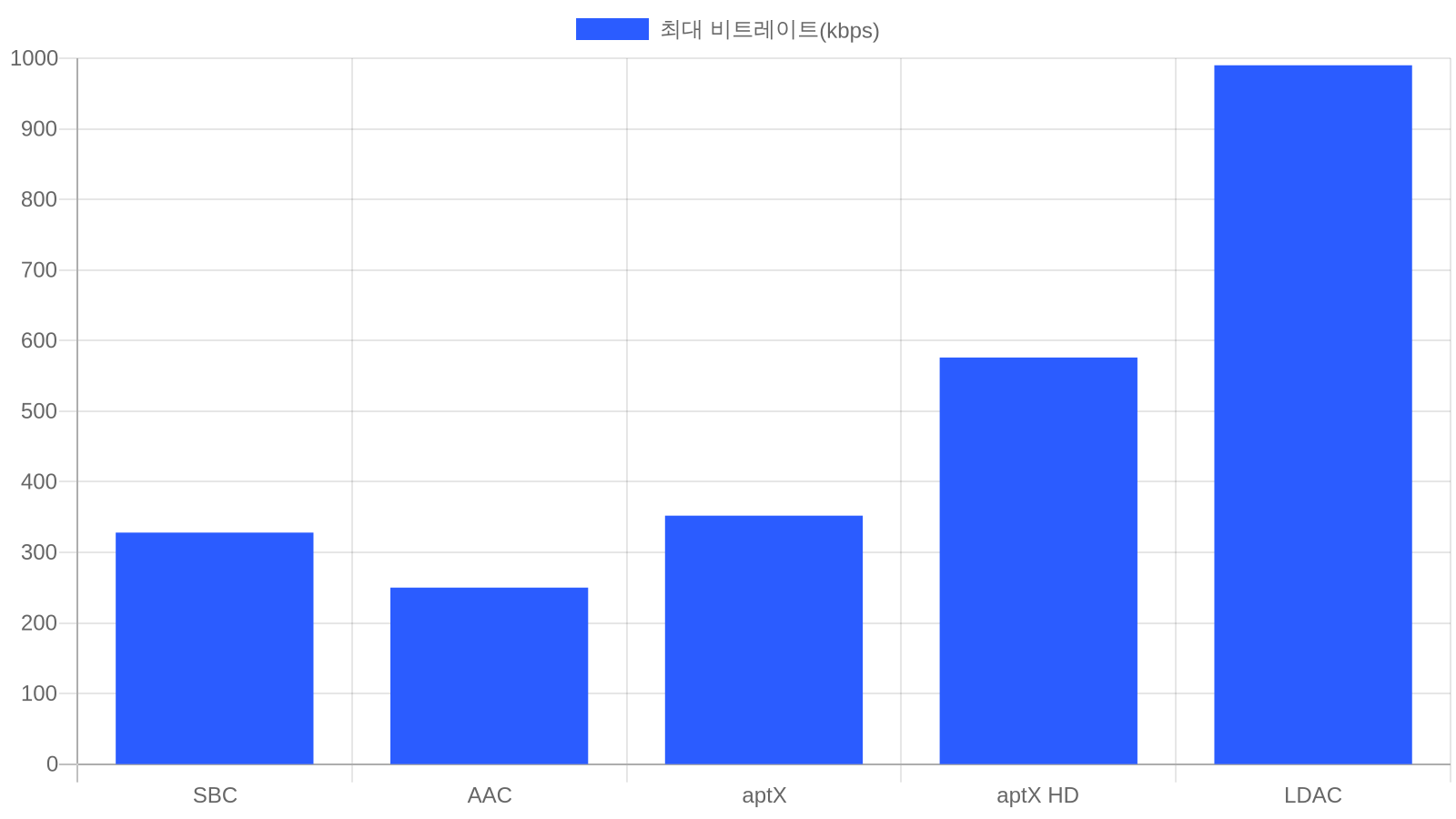
The chart below compares the maximum bitrate per publicly disclosed specs for each codec. A higher bitrate means more data can be transmitted in the same time period, theoretically reducing audio quality loss.
Three Axes Where the Codecs Actually Diverge
① Bitrate — The Upper Limit of Audio Quality Potential
Based on publicly disclosed specs, LDAC supports a maximum of 990kbps. Developed by Sony and now incorporated into AOSP (Android Open Source Project), this codec has the highest bitrate ceiling among the three. aptX is a Qualcomm-developed codec with a maximum of 352kbps, with its higher-tier variant aptX HD reaching up to 576kbps. AAC (Advanced Audio Coding), primarily adopted by Apple, has a maximum of approximately 250kbps.
However, bitrate figures do not directly determine perceived audio quality rankings. Each codec uses a different compression algorithm, and LDAC automatically switches between 990kbps mode and 660kbps or 330kbps modes based on Bluetooth environment conditions. In high-interference urban environments, LDAC may drop to a lower mode, reducing the practical difference from aptX. Based on publicly disclosed specs, the order is LDAC > aptX HD > aptX > AAC > SBC, but real-world rankings in actual listening environments can vary with signal conditions.
② Transmission Latency — The Perceptible Difference for Video and Gaming
If listening to music is your only purpose, transmission latency is not a significant concern. But for watching YouTube or Netflix videos, or playing mobile games, the situation changes. Lip sync issues or game sound effects arriving later than the on-screen action can be caused by codec latency.
Based on publicly disclosed specs, aptX Low Latency is designed to target latency below 40ms. LDAC, by contrast, has relatively longer latency due to its audio-quality-first design. AAC has significant latency variation depending on device implementation — in particular, how different Android manufacturers implement AAC means that AAC on iOS (iPhone) and AAC on Android can have meaningfully different practical performance. Gaming-focused earphones that emphasize a dedicated low-latency mode or aptX Adaptive do so against this backdrop.
③ Device Compatibility — It Is the Phone Spec, Not the Earphone Spec, That Decides
There is a commonly overlooked fact in codec compatibility. No matter how much an earphone supports LDAC, if the connected smartphone does not support LDAC, it automatically downgrades to SBC or AAC. LDAC has been included in AOSP since Android 8.0 (Oreo), but some manufacturers restrict or default-disable LDAC output on their devices. aptX and aptX HD are primarily supported on devices with Qualcomm Snapdragon chipsets, meaning budget phones based on MediaTek chipsets often do not support aptX.
AAC operates most reliably in the Apple ecosystem. The iPhone and AirPods combination is designed to implement AAC in an optimized environment. On Android, AAC implementation quality varies by manufacturer and chipset, so Android users treating AAC support alone as a selection criterion for earphones is not a sufficient basis for decision-making.
Codec Spec Comparison Summary
| Codec | Developer | Max Bitrate | Primary Strength | Key Caveat |
|---|---|---|---|---|
| SBC | Bluetooth SIG | ~328kbps | Universal compatibility (mandatory standard) | Low audio quality ceiling |
| AAC | MPEG / Apple-adopted | ~250kbps | Optimized for iOS environments | Large variation in Android implementation |
| aptX | Qualcomm | ~352kbps | Stable audio quality and latency balance | Primarily supported on Qualcomm devices |
| aptX HD | Qualcomm | ~576kbps | High-resolution audio source support | Narrow supported device range |
| LDAC | Sony | ~990kbps | Highest bitrate ceiling | Auto-downgrade based on signal environment |
Codec specs should be checked on the smartphone side first, not the earphone side — the support status of the transmitting device determines the upper limit of actual transmission quality.
Situations Where Codec Choice Becomes Meaningless
A common trap in codec discussions is the assumption that the codec alone is the sole determinant of audio quality. Driver quality in the earphone, eartip seal, and DSP (digital signal processing) tuning all affect final audio quality independently of the codec. A budget driver earphone supporting LDAC may not sound better than a premium-driver AAC-only earphone. Based on publicly disclosed specs, codec bitrate sets the "potential ceiling" of audio quality — actual realization depends on the overall hardware completeness.
The actual bitrate of your streaming audio source is also an important variable. Lossless streaming on Melon or Spotify is becoming more widespread, but audio delivered under standard subscription tiers is often at bitrates far below codec ceilings. If the audio source quality is lower than the codec ceiling, the practical difference between LDAC and aptX shrinks well below their theoretical values. In the end, codec specs are the most relevant selection criterion for users who primarily listen to high-resolution audio sources.
For users who prioritize ANC performance or microphone quality, focusing on those specs rather than codec is the more rational approach. Codec is one item on the purchase checklist — not the only one.
Who Should Prioritize Which Codec
- An Android user with a Sony, Samsung, or other LDAC-supporting device
- A hi-fi streaming or FLAC file listener who focuses on high-resolution audio sources
- Primarily using your earphones in a quiet indoor environment with low radio frequency interference
- iPhone users → AAC is the optimized choice within the iOS ecosystem
- Video and gaming-heavy users → Check for aptX Low Latency or aptX Adaptive support on the device
- Frequent commuters or urban environments with high signal interference → LDAC auto-downgrade is frequent; aptX's stability is more practical
- Anyone who has not checked their smartphone's codec support before buying → Check your phone's settings menu before looking at earphone codec specs
References
- Mobile Gaming CPU Focused on Performance and Efficiency: Intel Arc G3 Processor — IT Donga
- Diviiz CTO Kim Hyung-jin: "Expanding from Brainwave Analysis to a Platform That Encompasses Users' Lives" — IT Donga
※ This article is a spec deep-dive analysis based on publicly disclosed spec documents and technical white papers from Bluetooth SIG, Sony, Qualcomm, and other codec developers. Since the source material did not directly include codec-related figures, the article is written using each codec developer's officially published specs (LDAC 990kbps, aptX HD 576kbps, aptX 352kbps, AAC 250kbps, SBC 328kbps).